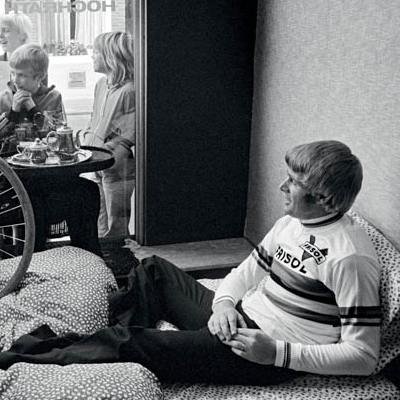
The frustration of Nico de Vries
The 1975 world championship is – after the 1972 Olympic title in Munich – the next high point in Hennie Kuiper’s career. Earlier that year he was crowned Dutch national champion. At that point Frisol is still the team that matters in the Netherlands. The opposition comes mainly from Peter Post’s outfit, Tube Investments (TI) Raleigh, which will later grow into the most successful team in the history of Dutch cycling. In 1975 the team is still in its infancy and does not yet have the quality to dictate a race.
The weather is foul on Sunday 22 June in Hoogerheide. Before the national championship Hennie has promised Ine that on Sunday night he will go to bed in the champion’s jersey. The professional national championship turns into a race of attrition. Kuiper is so nervous that his stomach rebels and the doctor has to give him pills to ease the discomfort. Despite that, he is there in the finale. Four riders are left: Joop Zoetemelk, Bert Pronk, Harm Ottenbros and Hennie Kuiper. Hennie pounds his rivals into submission with a barrage of attacks and wins by a margin of less than 20 metres. He already has a fine Vuelta behind him, a race in which he leaves the assembled Spanish climbing elite behind on the hardest mountain stage, only to see overall victory slip away through sheer bad luck – a freewheel that shatters into pieces. ‘It was a newly designed freewheel, super-light, that the mechanic turned up with. It looked fine. But, unfortunately…’ Hennie finishes fifth. In the Tour de France, in which the modest team bags no fewer than three stages – one from Cees Priem and two from Theo Smit – Hennie Kuiper finishes eleventh. In doing so he proves that he can hold his own with the best at the very highest level too. His time trials may not be top-class, but they are promising all the same: eighth in the first race against the clock and thirteenth in the second. He is not yet riding at the front on the cols, but he is nonetheless emerging as a rider of promise in the mountains.
Fedor
Although the Tukker, as people from Twente are known, can show a thoroughly creditable list of results, Frisol team director Nico de Vries is deeply dissatisfied with Kuiper’s performances. That has everything to do with his frustration that his great hero, Fedor den Hertog, has still not made his breakthrough. Fedor will not win a single race that season, any more than he did in his debut year as a professional – unless you count the national club championship, a title he has to share with his brother Nidi, ‘Dolle’ (‘Crazy’) Dries van Wijhe and Willem van Boven. Nevertheless De Vries lets it be known that, as far as he is concerned, Kuiper – whose contract runs until the end of 1976 – is free to leave. In the legendary Tour stage to Pra-Loup, where the Frenchman Bernard Thévenet takes the yellow jersey from Eddy Merckx, De Vries has seen that Hennie cannot stay with the real stars. He tells De Telegraaf: ‘He’s more interested in racing against Fedor den Hertog, I think. Well, that’s not much use to me.’ De Vries has heard that Kuiper has offers from Gitane, among others. As far as he is concerned, Kuiper can go at the end of the season. The Frisol director has already drawn a line through his name.
Contract with TI-Raleigh
What De Vries does not yet know is that Kuiper and his friend De Cauwer already have an offer in their pockets from Peter Post, who is busy building his Raleigh team into a top outfit. The salary at Raleigh, 54,000 guilders, is well above what his current team pays. When Kuiper is crowned world champion later that year, Post adjusts the contract. ‘We had agreed that in the contract talks, and Post kept to it.’ In 1976 the farmer’s son will earn 80,000 guilders at Raleigh – and that is his basic salary, mind you.
When the make-up of the teams for the Tour of the Netherlands – the last warm-up race before the World Championships – comes up for discussion, Frisol boss De Vries interferes in the running of the team by directeur sportif Libregts. He decrees that an A team is to be built around Fedor den Hertog and that Kuiper, De Cauwer and the others are to ride in the B team. Hennie scarcely notices the demotion. ‘All I was thinking about was the World Championships.’ De Cauwer does see it as a humiliation, but he does not lose any sleep over it. He is used to working as the underdog. The World Championships are Hennie’s main goal, so every evening after the stage in the Tour of the Netherlands he puts in some extra training with José. In the weeks before the championship the pair go out on training rides of up to 300 kilometres, whatever the weather.
De Cauwer, who knows from the outset that he will never, ever be picked for the formidable Belgian team, adapts completely to his team leader’s punishing training programme. They run a kind of company together, don’t they? Then they have to work for it together too. José supplies the tactics and the direction; Hennie the results on the bike. The Tukker, who has a bigger engine than the Fleming, wears his friend into the ground. ‘At the time I didn’t notice. I didn’t feel José’s pain, but he did everything for me, went beyond his limit in training, because he knew that punishing training was good for me. That was our friendship and our relationship in that period, and that’s how it has stayed to this day.’ The Kuiper-De Cauwer pair grows into a two-in-one. José the rider puts himself a hundred per cent at the service of his team leader. It helps that the two of them are the same height. In the grand tours and the classics, Hennie always has a spare bike riding in the peloton in case of a mechanical problem: De Cauwer’s. It even goes so far that De Cauwer sets up his handlebars, saddle and cleats exactly as Kuiper’s are. Hennie must not feel any difference should he have to change bikes.
In 1975 Hennie Kuiper is in his third professional season. He has been through a fair amount, has experience and has shown that he can do a thing or two. But a fight for the world title is something else altogether, especially since the setting is Yvoir, where the Belgian elite – led by Eddy Merckx, Roger De Vlaeminck and Freddy Maertens – are overwhelming favourites in front of their own public. In the days before the professional title race, the Dutch contingent at the World Championships enjoys unprecedented success. Roy Schuiten (pursuit), Gaby Minneboo (amateur motor-paced), André Gevers (amateur road race), Keetie van Oosten-Hage (women’s pursuit) and Tineke Fopma (women’s road race) all take world titles. But the climax, the battle for the professional world title, is still to come. And the whole of Belgium is convinced that one of their own will be crowned champion that Sunday.
Montreal
The foundations of Hennie Kuiper’s 1975 world title lie in the 1974 World Championships. A year before that, in 1973, Kuiper had already concluded that a great championship like this suited him. In the finale of that year’s race, held on the Montjuïc circuit near Barcelona, Gerben Karstens latched on to Hennie Kuiper.
‘Cramp,’ he said. Karstens was often up to jokes of that kind, and Kuiper snapped back irritably: ‘Bugger off.’ When he saw that ‘de Karst’ was not play-acting, that this renowned rider really was at the end of his strength while he himself did not feel the slightest pain, Hennie realised that he could play a part in a title race like this. He was determined to make the next world title race one of the main goals of his 1974 season. The 1974 World Championships are held in Montreal, in Canada. Hennie has studied the profile of the course. It is hard and gruelling, a job tailor-made for him. He prepares conscientiously. The KNWU has decided in advance that all the selected riders must travel out together eight days before the race. That is a problem for Hennie, because his sponsor, Robert Kahl, demands that the entire Rokado team starts the Grand Prix of Dortmund, the sponsor’s home base, the day after the departure the KNWU has planned. Anyone who fails to turn up can forget his salary for the rest of the year. Hennie is trapped.
Hennie Kuiper has no choice, and informs the federation bigwigs that he will make his own way to Canada. In Dortmund he shows that he is in top form. On the difficult course he beats Joseph Bruyère, Eddy Merckx’s first lieutenant, in the finale. After the race Hennie travels on to Frankfurt, spends the night there and then pays for a flight to Montreal out of his own pocket. When he arrives in Canada, nobody from the federation is there to meet him. But a hostess from the organisers makes sure he gets safely to the Dutch team’s lodgings. There a bitter disappointment awaits him. When he reports in, federation director Harry Meuwese asks what on earth he has come for. ‘To ride, of course.’ But he is not allowed to ride at all, because he has not kept to the rules. And the rules state that he is obliged to travel with the team. The gentlemen of the federation could not care less that, had he done so, his sponsor would not have paid him. No, the team has already been picked. Jos Schipper takes Kuiper’s place. When Kuiper offers Schipper a thousand guilders to give up his place, Schipper hesitates for a moment, but his sponsor forbids him to accept. ‘And I can understand that too, in a way.’
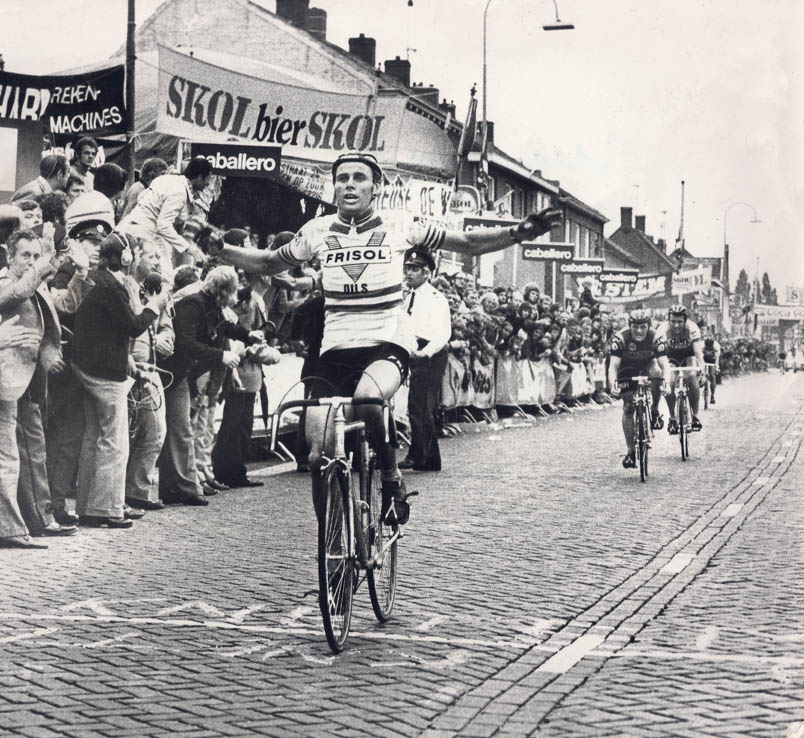
Hennie Kuiper crosses the line first in Hoogerheide, ahead of Bert Pronk and Joop Zoetemelk. The Dutch champion’s jersey goes with him to the Tour de France
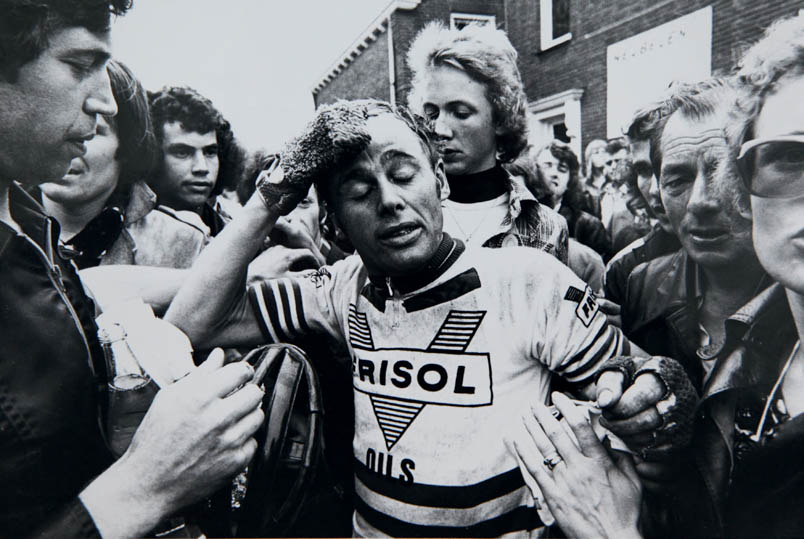
After the 1975 Dutch national championship in Hoogerheide, Hennie Kuiper freshens up among the spectators. On the far left, half of soigneur Rudy Bergmans can be seen; on the far right, half of Hennie’s wife Ine
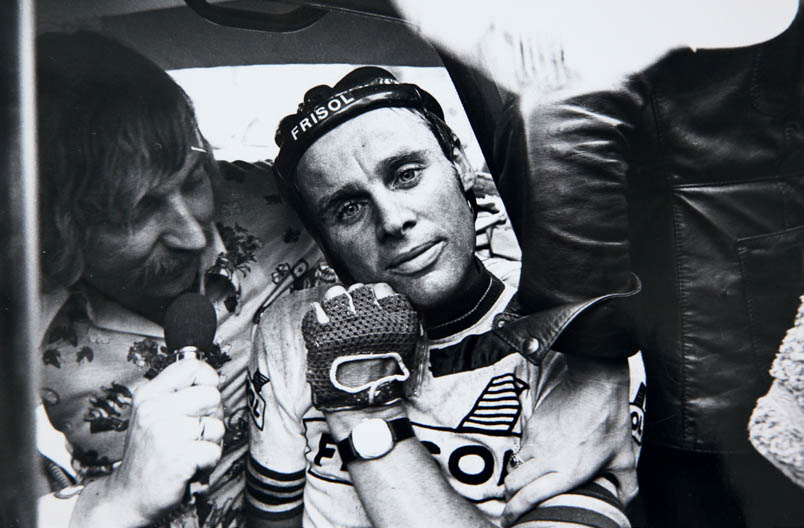
With a look of satisfaction in his eyes, Hennie Kuiper unbuckles his helmet. KRO’s Bep van Houdt has his microphone at the ready to put the first questions to the new Dutch champion
Desire-Believe-Do
And so that Sunday the Dutch professionals line up without the man who has prepared like no other. Hennie is inconsolable. He wanders along the course and settles down, utterly alone, near the university building. Kuiper cannot bear to have anyone around him. ‘I wanted to deal with the grief and the disappointment on my own.’ On the brutally selective course the championship is one long war of attrition. Only the strongest are still standing at the end of this gruelling battle. Eddy Merckx – who else? – is crowned professional world champion for the third time in his career. He finishes ahead of Raymond Poulidor, the ‘eternal second’. Two Dutchmen finish the race. At the back, that is: Tino Tabak is fourteenth and Gerben Karstens fifteenth of the eighteen riders who complete the course. Kuiper watches, grinding his teeth. With him in the race, the result would have been different… Deep inside, he is seething. He is bent on revenge, and he has a year to recharge. He thinks of his motto: Desire-Believe-Do. In this case: the Desire to play a leading role at next year’s World Championships, the Belief that he is capable of it, and the Doing – delivering a top performance – on the day itself. Those three elements, Desire-Believe-Do, had also been the foundation of his successful pursuit of the Olympic title in 1972.
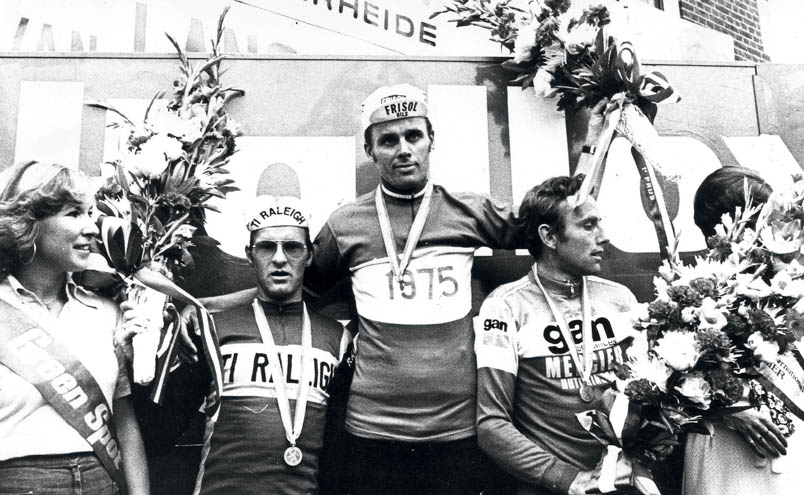
The podium of the 1975 Dutch national championship in Hoogerheide, from left to right: Bert Pronk, Hennie Kuiper and Joop Zoetemelk
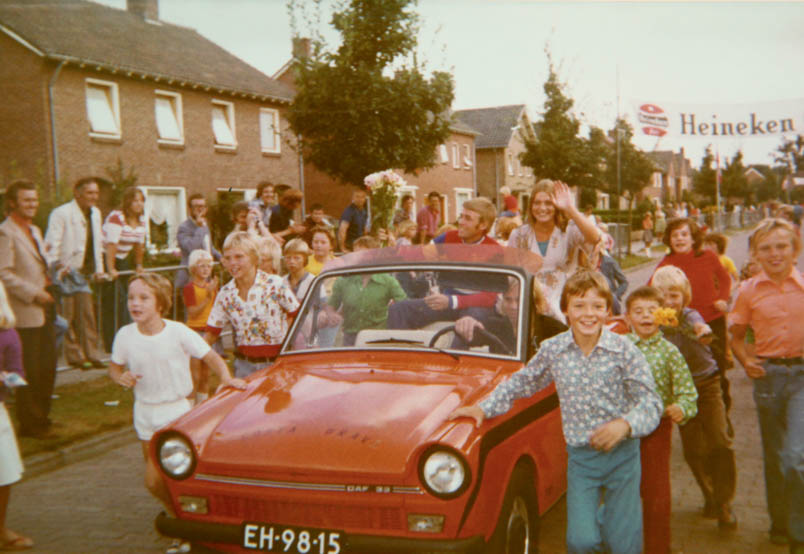
Grinning broadly in his national champion’s jersey, Hennie Kuiper is driven round on a lap of honour. It is hardly a commercial extravaganza, even if the bonnet of the DAF 33 is decorated with the words ‘Costa Brava’
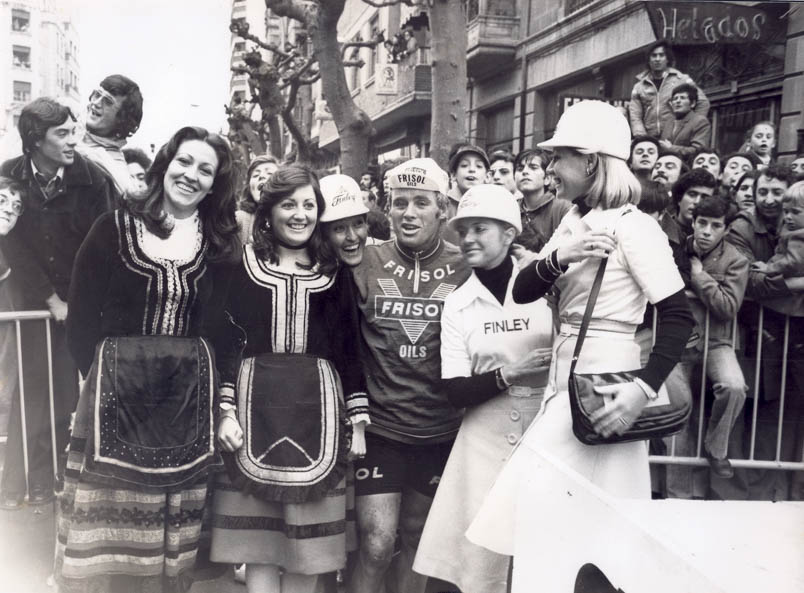
In cycling-mad Spain the fans hang over the barriers to catch a glimpse of stage winner Hennie Kuiper among the promotion girls
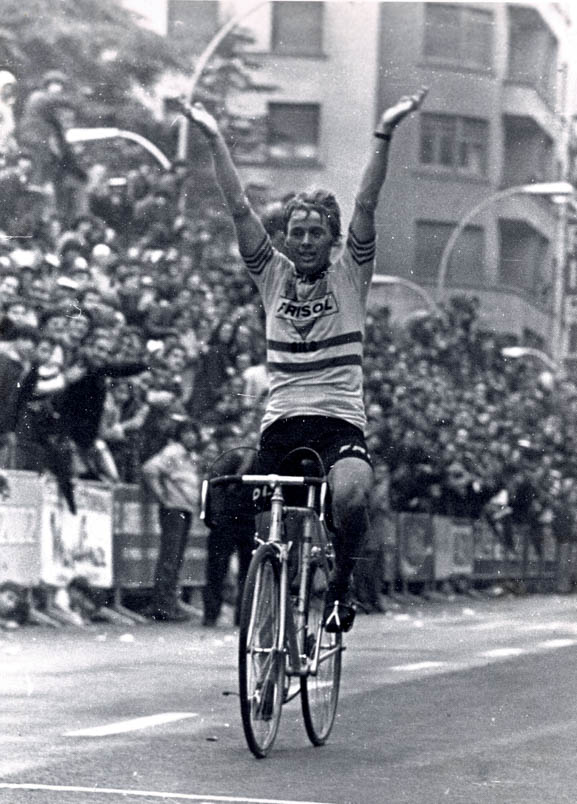
A great success for Hennie Kuiper in the 1975 Vuelta. On the penultimate day he wins the stage in Miranda de Ebro, the only Dutchman to win a stage that year
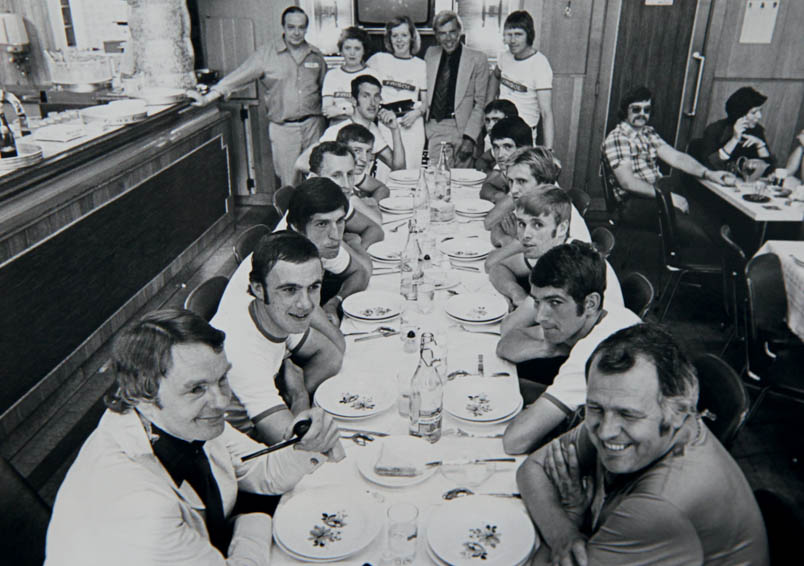
The Frisol team at table in Charleroi at the start of the 1975 Tour de France. On the left, from front to back: sponsor Nico de Vries (with pipe!), Theo Smit, Gerard Kamper, Ben Koken, José De Cauwer and Fedor den Hertog. On the right, from front to back: directeur sportif Piet Libregts, Cees Priem, Hennie Kuiper, Henk Prinsen, the Australian Don Allan and the Portuguese Fernando Mendes
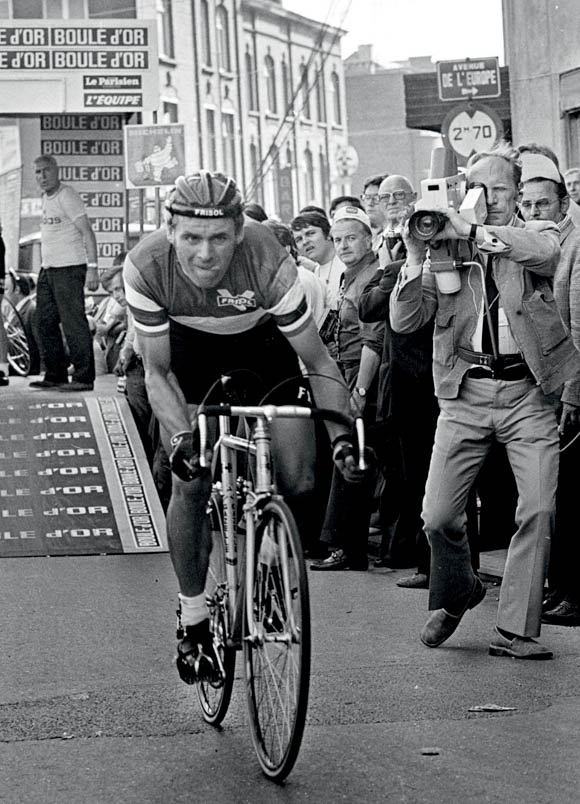
On 26 June 1975 Hennie Kuiper – tongue out – sets off in total concentration in the prologue of the Tour de France. The cameraman on the right is struggling to get Hennie properly in shot. Francesco Moser wins the race against the clock over 6.2 kilometres. Hennie finishes a very creditable tenth
Jan Janssen and the coalition
In 1975 Jan Janssen is coach of the Dutch team for the World Championships, a post that, by his own account, does not amount to much. The federation asked him to take it on and he accepted, partly because there is not much work attached to it. He knows Hennie and his wife Ine well. In Putte, on the Belgian border, he is more or less their neighbour. A few days before the race Janssen invites all the selected riders to his house in Putte. On the eve of the title race the mood there is the usual high-spirited one. Jan Janssen is thrown into his own swimming pool, fully clothed. From Janssen’s villa, ‘Mon Repos’, they set off by bike for Namur, where the Dutch team has a hotel. Janssen knows from experience that the team meeting on the eve of the World Championships is crucial. If the riders, who race against each other all year long in different sponsors’ teams, can forge an agreement to join forces for that one day, they can make their mark on the race. Without a coalition you stand no chance. The meeting goes smoothly. Joop Zoetemelk is the main candidate, but Gerrie Knetemann and Hennie Kuiper are also given protected status. If one of those three gets into a promising position, not only the rest of the team but also the other protected riders will defend that chance. There is a prize pot in case a Dutchman becomes world champion, to be shared among those who have genuinely done their bit. There are fifteen thousand guilders in the pot; the winner is expected to top it up with another twenty-five thousand. All in all, enough to weld the team into a unit.
But what about the opposition? Everyone is convinced that the danger will come above all from the Belgians. They are the great stars, and they will be racing in front of their own public too. First and foremost there is, of course, Eddy Merckx, who has something to put right. In July he was beaten in the Tour de France for the first time in his career. On the stage to Pra-Loup the Frenchman Bernard Thévenet took the yellow jersey from him. As it would later turn out, he would never win that coveted jersey again. Merckx is supremely motivated to show, with a world title, that he is still the boss of the cycling world. Beyond him there are at least three more contenders: Frans Verbeeck, who has won many a one-day race; Freddy Maertens, who has an impressive sprint and for whom the Yvoir course is only just not too hard; but above all Roger De Vlaeminck, who is in the middle of a superb season.
Roger De Vlaeminck’s superb season
As usual, De Vlaeminck begins the season with cyclo-cross, a branch of the sport that Hennie also takes part in, albeit at a much lower level. Kuiper, incidentally, is twice crowned national professional cyclo-cross champion, in a field dominated by amateurs. De Vlaeminck is coached by the physiotherapist Georges Debbaut, who once made a name for himself as a footballer. Debbaut introduces new training methods, impressing on the riders that they must already lay the foundations for the new season in the winter months. As late as the sixties many riders still believed that you had to save your strength in winter so that you could get stuck in again from the end of February. Debbaut, who takes Walter Godefroot and Roger De Vlaeminck under his wing, proves the opposite. In the woods around Lembeek and on the beaches of the coast he imposes a strict training regime on his athletes, in which the bike usually stays untouched. He is De Vlaeminck’s mental and physical mentor.
De Vlaeminck’s 1975 season gets off to a staggering start. The slender Belgian rides to both the national and the world cyclo-cross titles. On the road he is every bit as impressive. For the fourth year running he wins Tirreno-Adriatico, taking three stages, including the closing time trial. In Willy De Geest he has the domestique of his dreams. He does go down with flu after Tirreno, but once he has recovered he lines up for Paris-Roubaix, which he wins for the third time; this time ahead of Merckx, André Dierickx and Marc Demeyer. After that he beats the opposition in the Championship of Zurich. De Vlaeminck continues his triumphal march in the Giro d’Italia (seven stage wins, the points classification and the combined classification – the jersey for the rider who scores best across the general, points and mountains classifications). In the Tour de Suisse he wears the leader’s jersey from start to finish. Set Hennie Kuiper’s record against all this on the eve of the 1975 World Championships and you realise that, with the bookmakers, the Dutch champion is very much an outsider.
The donkey’s kick
The Belgian road race championship turns into a failure for De Vlaeminck. He thinks the course is not up to standard. He does still finish fourth, but he considers that beneath his dignity. After the national title race only one race counts for him: the World Championships in front of his own public in Yvoir. He keeps himself sharp in smaller races and criteriums. Ten victories prove that his form is still very good indeed. When the Belgian cycling federation announces its team for the World Championships, De Vlaeminck is furious. Merckx is given no fewer than three domestiques: Jos De Schoenmaecker, Ward Janssens and Joseph Bruyère. Freddy Maertens gets Michel Pollentier as his support. But the man who can show an unrivalled list of major victories that season, De Vlaeminck, has to manage without any help. There is no place for his faithful vassal, Willy De Geest.
De Vlaeminck is beside himself. He wonders whether he should even wear the Belgian jersey at the World Championships. ‘They’ve given me the donkey’s kick,’ he fumes. ‘This isn’t a team of eleven riders. It’s a team of ten plus one on his own. It would be best if those in charge let me ride in a white jersey, so that the public can see I’m the outcast of the team.’ De Vlaeminck goes his own way. He turns to his Italian sponsor and builds a strong support team around himself, so that whatever happens he can start as well prepared as possible. He secures the help of doctor Piero Modesti, soigneur Silvano Dago and two mechanics. The ever-nervous De Vlaeminck is moulded into a self-assured athlete.
And yet… in Yvoir it goes wrong for Roger, disastrously wrong. But not for Hennie! The seeds of his defeat lie partly with De Vlaeminck himself. On the eve of the World Championships the Belgian professionals hold a meeting too. During that team talk, led by Lomme Driessens – a man of a great many words, who always regards the riders’ successes as his own – De Vlaeminck decides to play the clown. Driessens opens the meeting by pointing to the quality and the quantity of the team. The outgoing world champion, in this case Eddy Merckx, always has the right to start. That means Belgium may start with one extra rider. ‘There are eleven of us,’ says Driessens. But then De Vlaeminck calls out, a little mockingly, in the small room where the team has gathered: ‘Whoa, whoa, whoa. There are ten and a half of us.’
The ‘half’ Lucien
That ‘half’ refers to the smallest of the company, the Belgian climber Lucien Van Impe. There is laughter: the ever-friendly little Lucien as the butt of the joke. José De Cauwer recognises it. Being short himself, he has just as often been the victim of ‘jokers’ who try to be funny at other people’s expense. ‘If you want to motivate your opponent, the best way is to needle him,’ says De Cauwer. Later, in the Raleigh team, De Cauwer sees something similar. There the shy Hennie is now and then teased about his stutter, mostly by glib-tongued riders from the west of the country. ‘That kind of taunting,’ De Cauwer knows, ‘lodges in your head, gets under your skin. The needling makes you furious. And if you can’t pay it back with words, you do it on the bike.’ Sometimes – as Hennie does now and then – by getting the better of the competition; at other times – as in the case of Lucien Van Impe – by refusing, at a World Championships, to throw yourself heart and soul into the chase of a breakaway rider. That is what happens when, during the World Championships, De Vlaeminck asks him to help bring back the escaped Kuiper. At first Van Impe refuses. After all, he is only half a rider, isn’t he? De Cauwer knows that belittling someone can be fatal. Kick a dog, and the animal will still remember it three years later. People are no different. ‘If you hurt someone, you always get paid back for it in the end.’
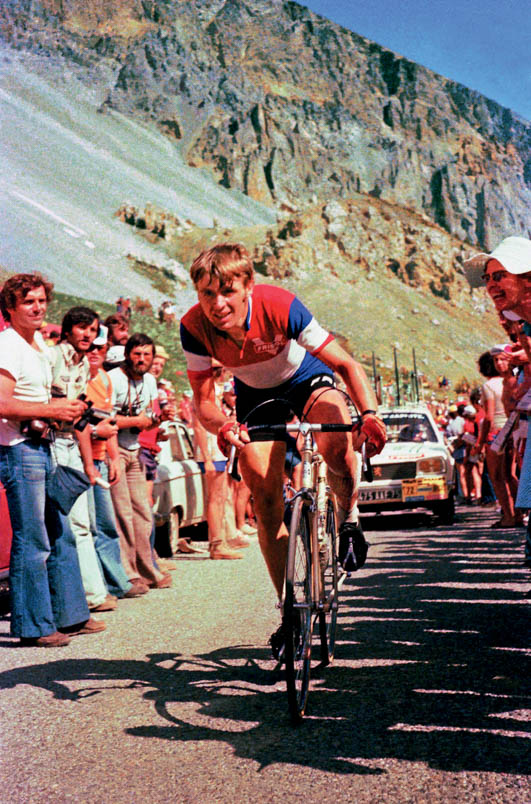
Hennie Kuiper shows the national champion’s jersey in the Tour de France. It is Monday 14 July, the French national holiday, which Bernard Thévenet’s stage win will make all the more festive. Hennie Kuiper toils alone on the slopes of the Col d’Izoard
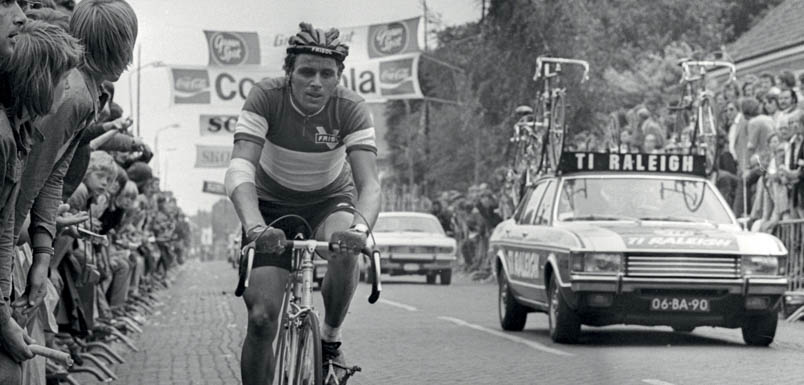
After the Tour the criterium circuit, too, wants to feast its eyes on the Dutch champion. Although Hennie Kuiper is trailing, the crowd almost comes through the barriers at the Acht van Chaam
Anti-Joop
On the eve of the World Championships the attitude of Belgian cycling fans towards the Dutch – or rather, towards Joop Zoetemelk – is openly hostile. In 1970, after his first Tour de France, Joop was widely acclaimed for finishing second as a debutant in the wake of Eddy Merckx; he was the hero. A year later he repeated the feat, once again beside the Belgian on the podium, but by then the cheering had fallen silent, in Belgium above all. The cycling public wants to see a fight, and hopes for a rival who will really attack Merckx, but Joop is no attacker: he hangs on. It is not in his nature to pick a fight with a rider who has greater gifts than he has; more than that, a fight with a rider the like of whom the world has never seen before. Zoetemelk knows he would lose that fight. Hanging on is hard enough.
In the Belgian press Joop is portrayed as a coward. Jokes do the rounds, such as: ‘Why does Zoetemelk look so pale?’ Answer: ‘Because he always rides in Merckx’s shadow.’ No, Joop is certainly not popular in Belgium. He is called a ‘wheelsucker’. Milk bottles hang in the trees along the course, meant to symbolise Joop’s pale skin and his surname (Zoetemelk means ‘sweet milk’). Joop is mocked. The Belgians have evidently forgotten how Eddy Merckx’s throne wobbled when Joop Zoetemelk swept up all the major stage races in the spring of 1974: Paris-Nice, the Catalan Week and the Tour de Romandie. Nobody – not even Eddy the Great – was fit to stand in his shadow. A disastrous and almost fatal crash in the Midi Libre put an end to all Joop Zoetemelk’s hopes. That year Merckx won his fifth and last Tour de France. It was the least lustrous of his Tour victories. ‘If’ Joop hadn’t crashed… But ‘if’ doesn’t count in sport. Hennie Kuiper: ‘Because of that crash Joop missed out on at least two Tour wins.’ And Hennie is not the only one who thinks so. None of that counts for the fanatical section of the Belgian fans as they line the World Championships course. In the morning the Dutch team is escorted by a group of ‘Zwaantjes’ (‘little swans’), motorcycle officers of the Belgian Rijkswacht, the national gendarmerie, whose job is to stop hotheads from laying into Dutch riders in general and Zoetemelk in particular. The coach on duty, Jan Janssen, also comes up against the anti-Dutch feeling. When he arrives at the start in his team car, he is approached by a gendarme on a motorbike. Would Mr Janssen kindly keep himself in check today? He is to behave ‘properly’ and do what everyone else does; in other words, toe the line. The gendarme has evidently caught the crowd’s anti-Zoetemelk mood, and Jan is the coach of the hated Joop.
And what happens during the race? Over race radio Janssen hears: puncture for Gerard Vianen. The coach drives the car up towards the peloton to deal with the problem, but then runs into the ‘little swan’ who gave him that warning before the start. Janssen tries to steer the car past the motorbike on the left, whereupon the gendarme also moves over to the left. When he tries on the right, the gendarme blocks his way again. Jan reacts furiously and rams the motorbike from behind. The gendarme ends up in the verge, motorbike and all. But Jan can drive on to the peloton, sort out Vianen’s wheel and take his place again in the line of team cars behind the bunch.
What Janssen has pulled out on the road is, of course, hardly clever. The gendarme who was knocked off has marched off to his superiors in high dudgeon. It goes against every rule: knocking a motorcycle policeman off his bike.
That Janssen gets off with a ‘serious warning’ he owes to the president of the KNWU, Piet van der Molen, a former police commissioner. Van der Molen has to use every ounce of his powers of persuasion, but he pulls it off: Janssen is spared. Without Van der Molen, the Netherlands’ first Tour winner could have counted on at least two weeks in prison. Joop Zoetemelk, the target of the hostility in Yvoir, still remembers the volleys of abuse on the way to the start and during the race. Countless times he heard the taunts: ‘wheelsucker’, ‘freeloader’. A great many fans have a dummy in their mouths, meant to symbolise him sucking Merckx’s wheel. Tomatoes are thrown in his direction, but none of the missiles hits its target. People have been whipped up, above all by the media. Joop realises that he runs the risk of being pushed off the road if he attacks. Zoetemelk: ‘Yet not for one moment did I feel afraid.’
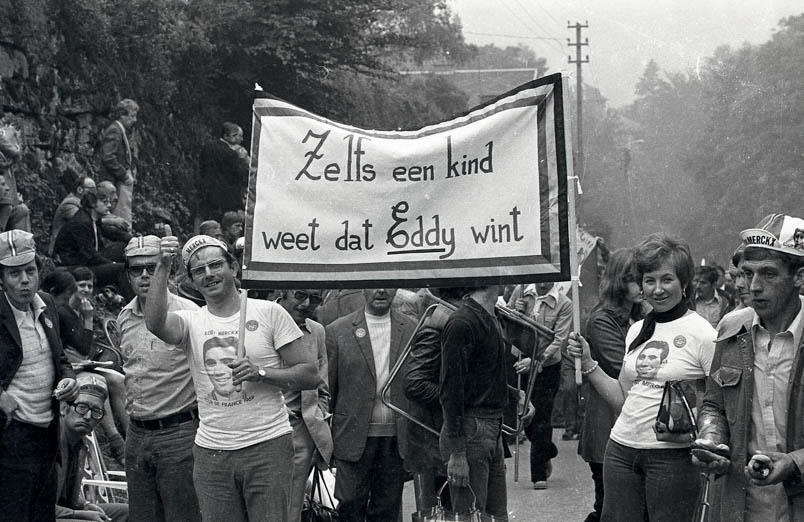
There may be 102 riders entered for the road race at the 1975 World Championships in Yvoir, Belgium, but for most of the fans the race revolves around just one man: Eddy Merckx…