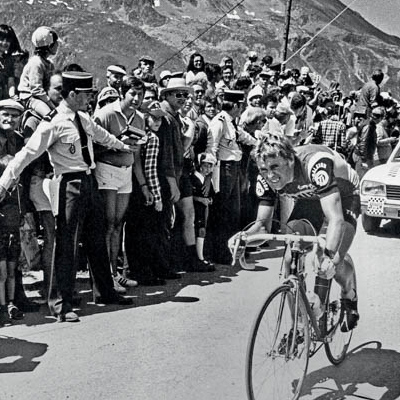
From Blonde to Fallen Angel
For Didi Thurau, 1977 is the high point of his career. That same year the world title is his for the taking, but on the course at San Cristóbal in Venezuela he sells the title to the Italian Francesco Moser for a bag of money. A stupid, short-sighted move by the money-hungry German. What happened? The bosses of his future sponsor IJsboerke felt that a rainbow jersey, however fine, left too little room for the sponsor’s advertising. That is why he is given the signal by the sponsor during the race: he may sell the title to Moser. That, at least, is the story that goes round immediately after the World Championships. But it is more than an idle rumour. Francesco Moser already has a reputation as the wheeler-dealer par excellence. In 1976, at the track championships that in those years preceded the road title races, Moser paid Roy Schuiten a hefty sum in the final of the world pursuit championship in Ostuni to be allowed to pull on the rainbow jersey. Schuiten later confirmed this too.
Hennie makes a strong impression in tropical San Cristóbal. He does not make the podium, admittedly, but with fourth place behind the Moser-Thurau duo and the Italian Franco Bitossi, Kuiper shows once again that he belongs among the very best in tough one-day races too. In the jersey of IJsboerke, his sponsor after the Raleigh years, Didi Thurau – whom the German press calls the ‘Blonde Angel’ – still performs reasonably well at first, although he never again reaches the high level of the days when he rode for Peter Post’s Raleigh team. Thurau does go on to win the Championship of Zurich (1978), Liège-Bastogne-Liège (1979), the Tour of Germany (1979), and stages in the Giro d’Italia (1978) and the Tour de France (1979), and takes second place behind Jan Raas at the World Championships in Valkenburg (1979). But after that the harvest grows leaner by the year. For a rider of his class he builds up a disappointingly modest palmarès.
Doping affairs
From 1980 onwards he draws attention mainly through doping affairs. Insiders are not surprised. He has barely been at Raleigh a year when he shows Jules De Wever, Peter Post’s assistant directeur sportif, a small case. ‘Mein Geheimnis’ – my secret – says the young talent. De Wever recoils in alarm when he sees what is inside. ‘A row of ampoules, neatly lined up. Next to them a number of hypodermic needles.’ De Wever, in an interview in 2004: ‘That Thurau was going about it all wrong. I tried to get him off that junk. But whether I succeeded…’
In his Raleigh days Thurau is never caught. But from 1980 onwards he tests positive four times. In 1987 the paths of Thurau and Kuiper cross again, in the Roland-Skala team. Didi and Hennie – ten years after the 1977 Tour de France that was so successful for both of them – are quite clearly past their best. Their sons have almost the same name. Didi’s Björn, unlike Hennie’s Bjorn, does follow in his father’s footsteps as a cyclist, but will not set the world alight. Any further comparison between Thurau and Kuiper does not hold up at all, especially in private life. Thurau is successful on the winter tracks, where glamour and show matter more than sporting achievement. It suits Thurau better than hard graft on the road. The world of show business, where he can parade his Porsches and Ferraris and appears in fur coats and sharply cut tailored suits, is where he feels at home. The track promoters, especially those in Germany, fight to get his signature on the lucrative contracts they put in front of him. Now and then things get out of hand, as at the Dortmund Six Days in 1982, where he comes to blows with the organiser and is thrown out of the race, but on the whole ‘der Didi’ is a welcome guest on the tracks. He pockets sums of up to 50,000 marks for six days of circling the wooden ovals.
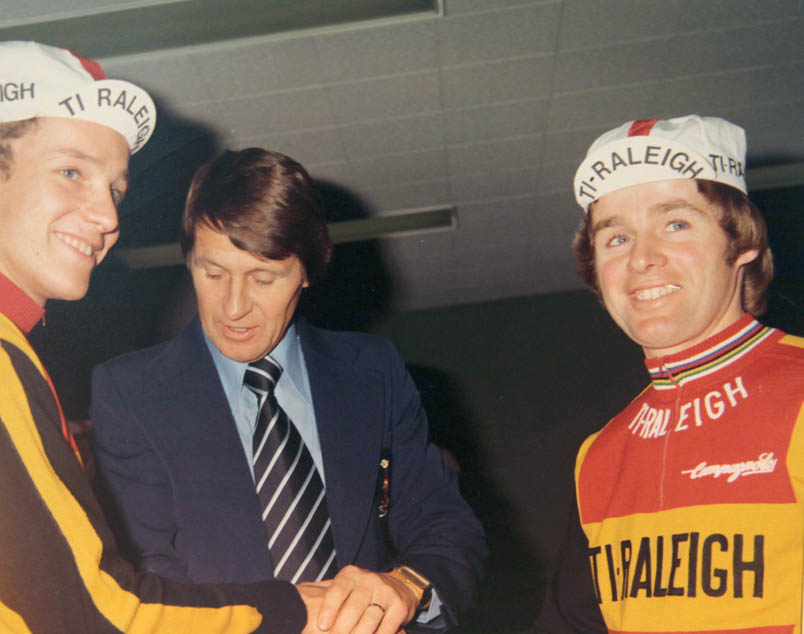
Peter Post’s two aces in the line-up of ‘the firm’, TI-Raleigh: Didi Thurau and Hennie Kuiper. Peter Post has eyes above all for Thurau
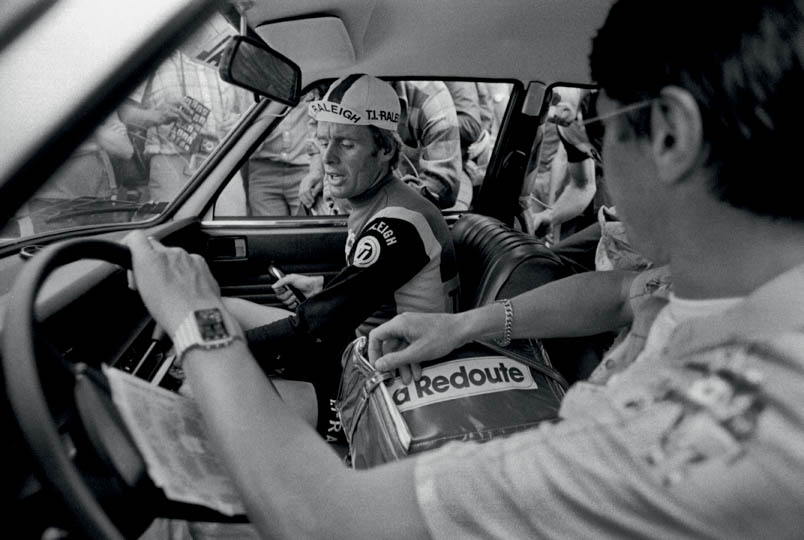
Hennie Kuiper gets into Peter Post’s team car after a stage of the 1977 Tour
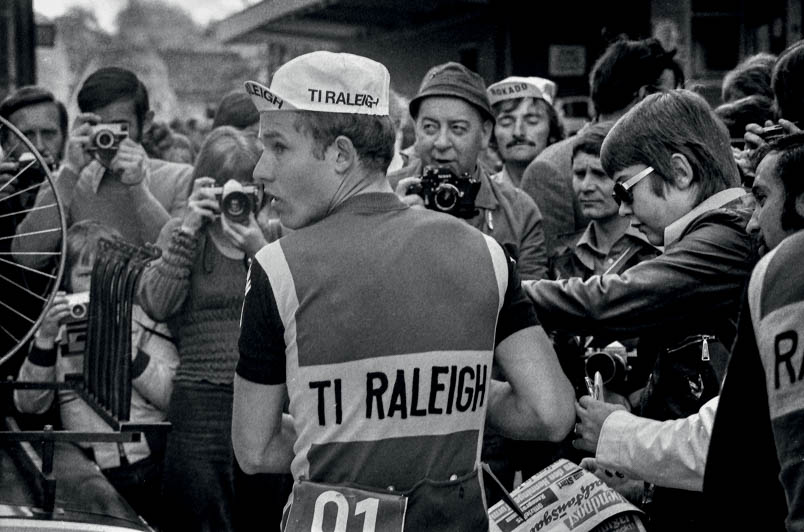
Before the start of Rund um den Henninger Turm, crowds gather in Frankfurt to catch a glimpse of the German Raleigh hero Didi Thurau
A fortune
Twenty-nine times he is fêted as the winner of one of these spectacles of show and sport. That none of it helps his preparation for the road season does not bother him. In the 1981-1982 winter season he signs no fewer than six six-day contracts. It earns him a fortune, but his preparation for the road suffers as a result. The long spells in stuffy, beer-soaked, smoke-filled sports halls damage his condition. And that shows as soon as he ventures onto the road. He is unmanageable, and changes teams as easily as he changes shirts. He has any number of conflicts. In 1985 he comes to blows with an official in the Tour de France. He is thrown out of the race. His honours list barely grows any more. Fifth place in the 1983 Giro and, in 1987, a stage win in the Tour de Suisse – in the time trial between Basel and Birsfelden – are the rare high points in races of any importance. For his last success, the Tour de Suisse time trial, he is riding in the jersey of the Belgian Skala team, of which Hennie Kuiper is also a member. They are Thurau’s last exploits of the eighties.
After that the ‘Blonde Angel’ increasingly turns into the ‘Fallen Angel’, as the Belgian magazine Cyclo Sprint put it in 2012. Between 10 October 1974, when Peter Post signs him for his Raleigh team at the World Championships in Montreal, and his last year in cycling in 1989, he wears the jerseys of no fewer than thirteen different sponsors. In 1982 he even gets through three different sponsors in a single year. At Kotter he is sacked in the spring for poor performances. Hoonved hires Thurau for two months. He will only get a follow-up contract if he performs well in the Tour, but Thurau does not finish the Tour. Finally Toshiba takes him on in August for the last five months of the year. In his last season, 1989, his backer Brügelmann lets Thurau ride around anonymously. Der Didi has no teammates. He is utterly alone. It is symptomatic of his final decline.
AN OVERVIEW OF THURAU’S TEAMS
| 1974-1977 | TI-Raleigh |
| 1978-1979 | IJsboerke |
| 1980 | Puch-Sem |
| 1981 | Kotter-GBC |
| 1982 | Kotter-Bibione (until 30-04) |
| 1982 | Hoonved-Bottecchia (01-05 to 31-07) |
| 1982 | Toshiba (from 01-08) |
| 1983 | Del Tongo-Colnago |
| 1984 | Portas-Didi Thurau |
| 1985 | Portas-Didi Thurau (until 31-01) |
| 1985 | Hitachi-Sunair-Splendor (from 01-02) |
| 1986 | Supermercati Brianzoli |
| 1987 | Roland-Skala (until 31-10) |
| 1987 | Panasonic-Isostar (from 11-11) |
| 1988 | Panasonic-Isostar |
Even after his career ‘der Didi’ remains a ‘Fallen Angel’. He regularly falls foul of the law. One moment he is deep in debt through the dubious practices of his property company; the next he is fined 10,000 German marks for racing the wrong way down a one-way street at high speed; or he is sentenced to six months in prison for forging a building permit. That he is fined for kicking a dog and for hitting a woman fits the pattern of the ‘Fallen Angel’.
The moral low point is his conviction for embezzling the benefit meant for his disabled father. In all, the former cycling star pockets 49,000 marks that were intended for his father. Thurau senior was once his most ardent supporter. He put Didi on a racing bike, but later there is no trace of any respect or gratitude from the son towards his father. Quite the opposite. When his father, Helmut Thurau, suffers a spinal cord injury in a cycling accident, he receives an allowance to pay for his care.
The money is paid to his son Didi, because Didi is mobile and will manage it. But Didi passes nothing on to his father, who, despite a string of phone calls, does not receive another cent from his son. For eleven months Thurau senior waits in vain. Then he brings in a lawyer, who files a complaint against junior.
When the case comes to court, Didi fails to appear. ‘I’m snowed in in Switzerland,’ he informs the court. The judge does not fall for it. Father Helmut Thurau senior has a bill for his dear son Didi: 49,000 euros. The judge fines the sinner 39,900 euros.
Whether he has learned anything from all this is doubtful. Didi Thurau remains a thoroughly unreliable egoist. In 2017 he agrees to take part in an episode of the television programme Andere Tijden Sport about Hennie Kuiper: ‘De verloren Tour van 1977’ (‘The lost Tour of 1977’). But on the day of filming he cries off a few hours before the appointment. Despite strenuous efforts by the documentary makers Bas Steman and Wiep Idzenga to get in touch, nothing more is heard from him. That is in stark contrast to Hennie Kuiper, who has always kept his word. There is – fortunately – a world of difference between the ‘Fallen Angel’ and Hennie Kuiper – whom soigneur Ruud Bakker called ‘Bellefleur’ because of his ever-rosy cheeks. In 1977 Peter Post made the wrong choice in every respect by playing the Thurau card.
Honoured
On 6 January 1978, chiefly because of his performance on l’Alpe d’Huez, Hennie Kuiper is crowned Dutch Sportsman of the Year for 1977. He is pleased with the award and the trophy that goes with it, the Jaap Eden Trophy, but he feels he should have received the honour earlier: in 1975, to be precise. That year he is national cyclo-cross champion, wins the national road title and takes the world title in Yvoir. ‘For me it was a big disappointment at the end of that season that I wasn’t chosen as Sportsman of the Year.’
For at the beginning of 1976, in the Singer concert hall in Laren, the title goes to the runner Jos Hermens. In the book De ontdekking van Dafne, Hermens is rather dismissive when talking to the author Kees Sluys: ‘I do remember that Hennie Kuiper got angry about that. I think he’d won a couple of classics that year.’
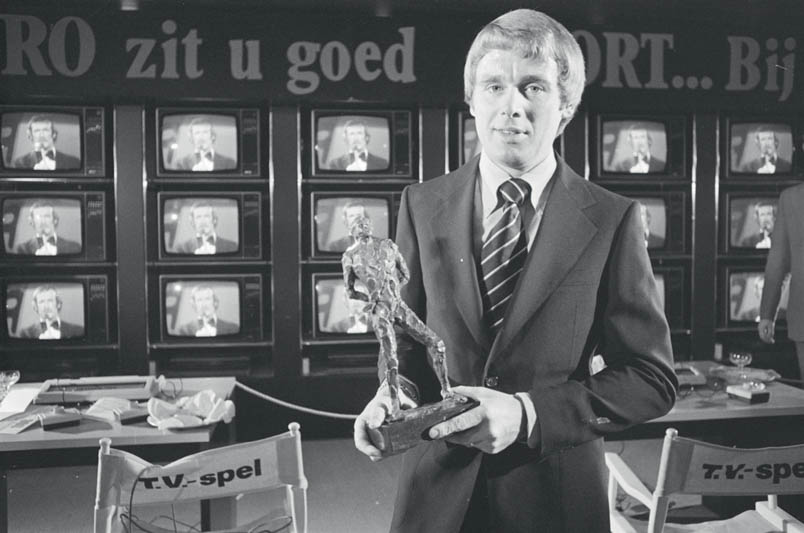
At the beginning of 1978 Hennie Kuiper receives the Jaap Eden Trophy from the AVRO (‘Bij de AVRO zit je goed’ – ‘You’re in good hands with the AVRO’). He has fully earned the award as Sportsman of the Year 1977
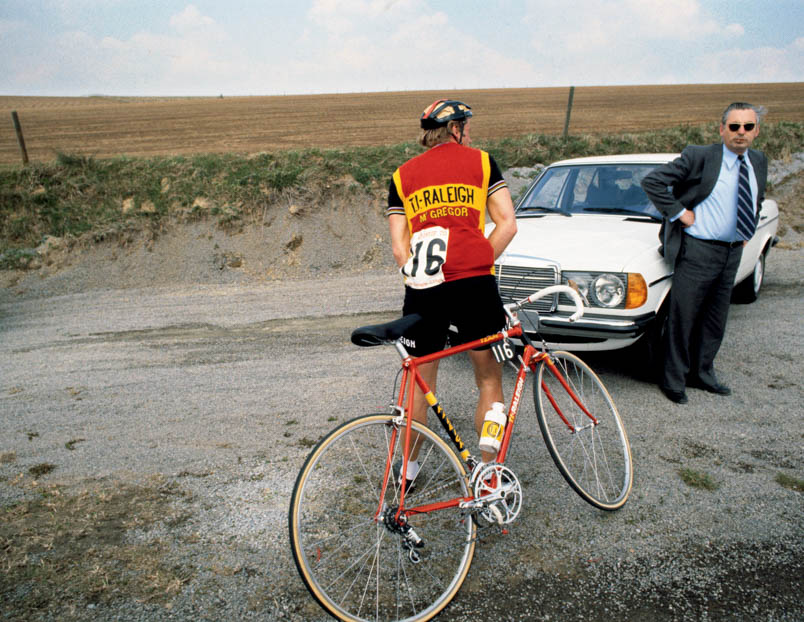
Hennie Kuiper makes an emergency comfort stop. The owner of the white Mercedes fixes his gaze on photographer Hans Heus