Leaving TI-Raleigh
Cycling fans across the Netherlands look forward eagerly to the 1978 season, and above all to the Tour de France, which starts in Leiden. By now Peter Post’s team is playing a leading role on every front. Tactically, however, the directeur sportif is not the great mastermind he makes himself out to be. That role falls first of all to Jan Raas or – in his absence – to Gerrie Knetemann.
When it comes to organisation, though, Post is unsurpassed. Everything in the team is just right. The riders are impeccably turned out. A world away from the sixties, when many European cycling teams – the Italians excepted – were often shabbily dressed, frequently stayed in grubby third-rate hotels, and when many riders had no table manners to speak of. Peter Post changed the image of cycling and, from the very first days of the Raleigh team, built a tightly run organisation to be proud of. On Johan Cruyff’s advice Post dresses his riders in fashionable black leather jackets. He also brings in good professionals. In Jan Legrand he has a true wizard with equipment, who spends every winter at the Raleigh factory in Nottingham working on improvements, and in Ruud Bakker a soigneur you can rely on. The Raleigh organisation is rock solid.
Farewell to Raleigh
At the start of this Tour de France in Leiden, Hennie already knows that he will leave Raleigh at the end of the season. Two years earlier he had let Peter Post steamroller him in the contract talks and signed for two seasons. Together with his ‘partner’, José De Cauwer, he decided there and then that once those two years were up they would close the door on the successful team behind them. Even so, Hennie hesitates at first. ‘You can want to leave all you like, but you also need somewhere to go.’ But he is not happy, and that is mainly down to directeur sportif Post, who time and again undervalues the performances of his most important rider for the overall classification. No: if Kuiper gets the chance, he is gone.
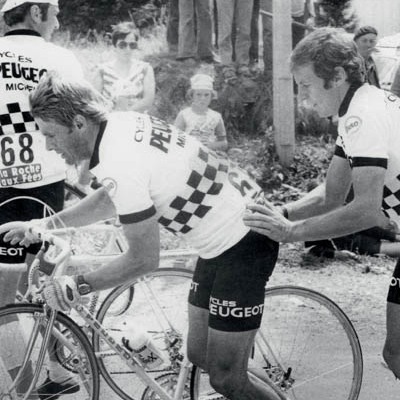
During the Dauphiné Libéré Kuiper receives a visit from the Peugeot boss Maurice De Muer, who is keen to have him in the team. Hennie responds with enthusiasm. After all, De Muer has already had a winner in his team in three Tours: Luis Ocaña in 1973 and Bernard Thévenet in 1975 and 1977. For the French the Tour is always the main goal. The same goes for Hennie. He is offered the position of joint team leader, alongside Thévenet. That is not without reason. De Muer has concluded that Thévenet is past his peak. He has looked within France’s borders for a successor, but has found no one with the ability to follow in Thévenet’s footsteps. He would have loved to sign the young star in the cycling firmament, Bernard Hinault, but Hinault has signed a contract with directeur sportif Cyrille Guimard. So he has been sniffing around foreign teams. Through the grapevine he has heard that at Raleigh relations between the team leader and the directeur sportif are less than ideal. And Hennie Kuiper is praised in the French press, too, as a genuine attacker and, what is more, a potential Tour winner. Hence his approach to Kuiper.
The talks go smoothly on both sides. De Muer offers a basic salary more than double what Kuiper earns at Raleigh: 150,000 guilders. Set that against the 72,000 guilders from Raleigh and anyone will understand why Hennie feels more appreciated by the pay De Muer holds out to him than by what Post pays him.
Hennie remains scrupulously correct. Despite all the friction with his directeur sportif, he has not gone to Post and announced ‘I’m leaving’. No, Hennie wants to give Post the chance to make a counter-offer. But Hennie can say what he likes: Post will not budge and refuses to pay a cent more. The Amstelveen man would very much like to know which team has made the offer. On that score Hennie gives nothing away. ‘If I’m evidently worth that much to another team, surely Raleigh can pay me that too?’ All he gets in reply is: ‘Hennie, you don’t know what you’ll be missing if you leave us. On top of your contract you earn so much extra in win bonuses – you won’t earn that anywhere else.’
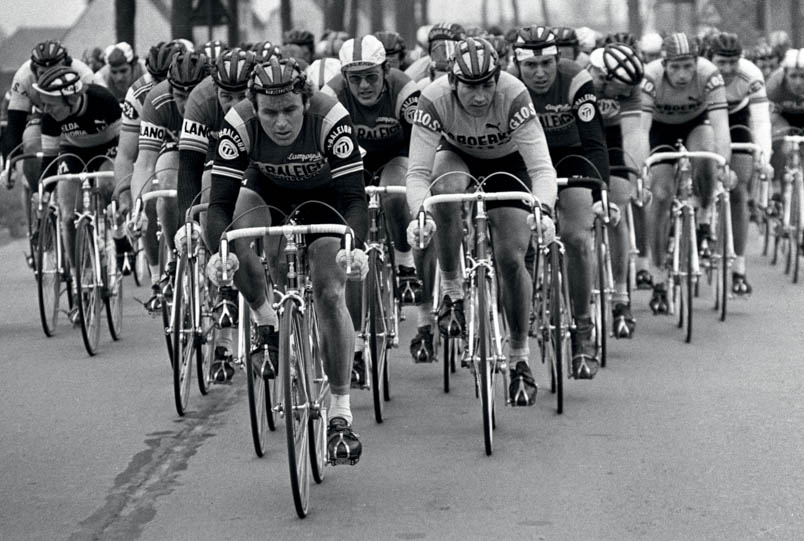
The Raleigh riders take control in the 1978 Omloop Het Volk. Hennie Kuiper goes to the front of the bunch. On the far left of the road is Michel Pollentier. Behind Hennie Kuiper on the right is Gerrie Knetemann, flanked in turn by Gerben Karstens. Ludo Delcroix pedals in front of those two
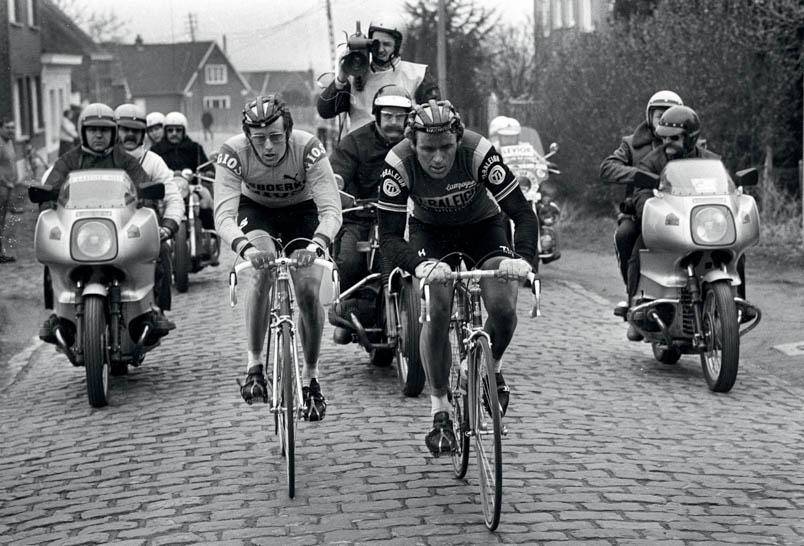
The nine leaders in the 1978 Omloop Het Volk are not caught until 25 kilometres from the end. Earlier in the race Hennie Kuiper and Eric Van de Wiele try to wrest themselves free of the other seven escapees
A pat on the back
Once again Kuiper feels undervalued. Post is nowhere near willing to pay him what he is really worth. The directeur sportif from Amstelveen never did rate the Twente rider very highly. José De Cauwer has seen that often enough over the years. ‘Behind Hennie’s back he would quite often make a dismissive gesture when the name Kuiper came up. And Hennie, who can sense that, then works even harder. He wants to prove time and again that he can do it. And he shows it with results, too. But the reward, the pat on the back, never comes. Hennie longs for a small human gesture like that. It doesn’t come; there is no chemistry between the team boss and his team leader.’
Nor, for that matter, between Post and Hennie’s friend De Cauwer. ‘In all those years he never once paid me a compliment. And I didn’t only work for Hennie, I worked for the team as well.’ In the Tour, the third man home in each stage counts towards the team classification. On hilly courses De Cauwer is quite often that third man. He will have done a domestique’s work first, and then in the finale he gives everything he has left to get in as fast as he can for the sake of the day’s team classification. ‘All you hear is: “Allez, allez!” If I get dropped by the group, Post acts as if I don’t exist. The only one who shows any appreciation is Jan Legrand, who sits in the back of the team car. He gives me a thumbs-up as he drives past. A gesture like that keeps me going for a while.’
Post looks on at the teasing at the dinner table, where Hennie is often the butt of the jokes. Henk Lubberding finds the bullying embarrassing. In his first year as a professional – 1977 – the farmer’s son from Voorst in Gelderland is confronted with the situation. ‘Sometimes I really felt for little Kuiper. There’d be some banter going on at the table, Hennie would want to say something and Karstens would shout: “God damn it, Kuiper, spit it out, k…k…k…” Trying to be funny at other people’s expense. It was meant as a joke, but just imagine being in little Kuiper’s shoes. Everyone’s having a good time at the table, everyone has their say, Hennie wants to join in too, but he gets stuck, and then something like that gets thrown at him. That hits hard.’
Hennie himself felt quite differently about it. ‘I really didn’t experience it as teasing. Quietly, I could even enjoy the acts that each of them put on.’ His creed: the peloton is a society in miniature, in which all sorts of oddballs find their place. Lubberding is rightly harsh in condemning the tormentors: ‘With Karstens in those days it’s at other people’s expense. Leo van Vliet is prone to it too. The art is to be funny without damaging anyone, because that hurts the other person. And Hennie Kuiper is very sensitive to it.’ Hennie himself says: ‘I let it wash over me.’
The relatively low salary at Raleigh, Post’s lack of appreciation and above all the lack of support in his bid to win the Tour: these are all factors that lead Hennie to accept De Muer’s offer. That last one – winning the Tour – is something he believes he can achieve with De Muer. ‘His way of working appealed to me,’ says Hennie. ‘In 1975, when Thévenet took the jersey off Merckx, De Muer was preaching attack again the very next day. And that is how Merckx was finally beaten. That was good tactics on De Muer’s part.’ He thinks back to Post’s tactical plans. ‘I’d ride back to the team car and the answer I’d get was: “Just do something.” What use is that to anyone? So there was no tactical plan at all.’ In the weeks before the start of the Tour, Peter Post does everything he can to find out which team Hennie will be riding for the following year. Those directly involved are all as silent as the grave, to the great frustration of Post, who always prides himself on being the first to know everything. He puts Kuiper under enormous pressure.
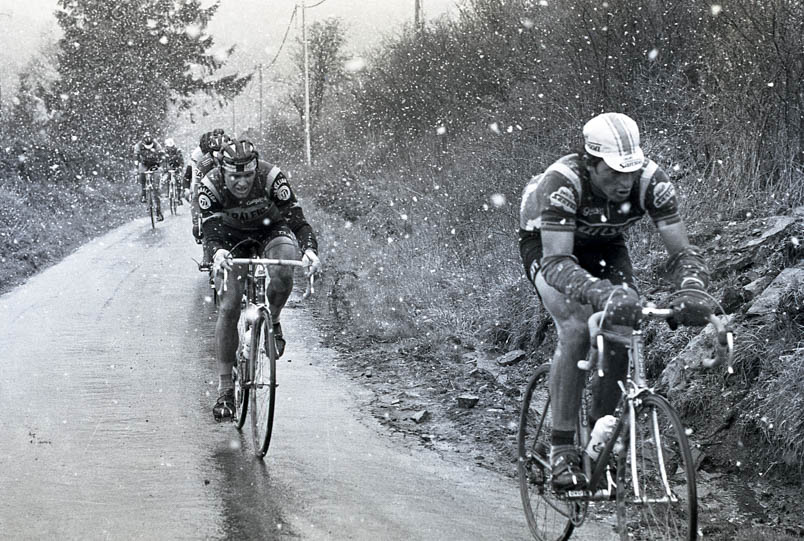
It snows in the 1977 Liège-Bastogne-Liège too. Not as heavily as in 1980, admittedly, but Hennie Kuiper will not finish the race. The 1977 winner, incidentally, is the same as in 1980: Bernard Hinault. Here, on the climb of the Stockeu, Kuiper sits on the wheel of the Italian Francesco Moser
A threat
On the day before the national championship, the race traditionally held a week before the Tour, the Raleigh team is staying at the Hotel Mercure in Born, in Limburg. Post is still furious with Kuiper and lets him know it. He threatens: ‘I’ll leave you at home. You’re not coming to the Tour.’ But Hennie knows full well that Post is bluffing. ‘It’s scaremongering. I’m his best rider for the overall classification and I was runner-up in last year’s Tour. I know him: he can get reeeeally angry when he doesn’t get his way.’
In the Tour de France there is an armed truce between Peter Post and Hennie Kuiper. Post understands perfectly well that he has to be careful with the Twente rider. Since the ’77 Tour, after all, Kuiper has been a national idol. And an idol has to be handled with due care if you don’t want the whole public turning against you. That season the team racks up one victory after another. Jan Raas is the undisputed king of the classics and the team’s great tactician, Gerrie Knetemann the man for time trials and shorter stage races, and Hennie Kuiper is Raleigh’s trump card for the big one, the Tour de France. These men are surrounded by helpers who are capable of leading roles themselves: riders such as the winner of the Tour de Suisse (the Belgian Paul Wellens), Henk Lubberding, and Johan van der Velde, winner of the Tour de Romandie. In the Raleigh team there are three team leaders with a ‘personal assistant’ of their own: Kuiper with De Cauwer, Raas with Priem and Knetemann with Van den Hoek. These pairs, plus Wellens, Van der Velde and Lubberding, form the heart of Post’s team.
Almost all of them ride the 1978 Tour. Only the neo-pro Johan van der Velde has to wait another year, and Priem is replaced by Wilfried Wesemael, in whom Raas has a helper at least as devoted. Gerben Karstens and the German Klaus-Peter Thaler complete the team that starts the 65th Tour de France on home soil on 29 June. It begins in Leiden with a prologue. There is plenty of excitement straight away. When the classification is drawn up afterwards, four Dutchmen turn out to head the standings. Behind the winner Jan Raas come Gerrie Knetemann, Joop Zoetemelk and Hennie Kuiper.
Too much orange
That is an awful lot of orange, Tour director Félix Lévitan must have thought. The rain has meant that not all the riders could race in exactly the same conditions. But where are conditions ever exactly the same? Lévitan seizes on the rain as grounds to respect the result, yet neither award the yellow jersey nor let the times count towards the classification. To the fury of the organisers in Leiden; to the frustration of the riders. Jan Raas is beside himself. Furious: ‘Tomorrow only one man is going to win: me.’ Hennie Kuiper is absolutely certain that something very different from the changing weather lies behind the Tour director’s decision. ‘It was all to do with the main sponsor, Peugeot. The winner of the previous Tour gets to wear the yellow jersey in the opening stage. By not counting the prologue, they let the Peugeot rider Bernard Thévenet ride through the Netherlands in yellow on the first day. All the cameras were on him. Nice publicity for Peugeot.’ It lasts precisely one day. For in the first stage Jan Raas takes his revenge with a crushing sprint. The yellow jersey he then gets to wear, he regards as his revenge on Lévitan.
Between Leiden and the stage town of Sint Willebrord, the Dutch riders have been able to see for themselves how much the popularity of cycling has grown in their own country. Hennie Kuiper still looks back on it with visible pleasure. ‘Banners everywhere, constant encouragement, banners with my name on them.’
‘Kuipertje’ (little Kuiper) is extraordinarily popular. He is always counted among the small group of contenders: the new French talent Bernard Hinault, the Belgian Lucien Van Impe, Joop Zoetemelk, who is once again racing for a French sponsor, and Hennie Kuiper, thanks to his irrepressible attacking spirit the most popular Dutch rider. Along the route he hears his name chanted countless times. He savours every moment. Ten years earlier an anonymous Tukker, as people from Twente are known; now a national hero.
‘Goosebumps,’ he says himself.
The hero totters on his pedestal in the public’s eyes when, in the Pyrenees and on the Puy-de-Dôme, he loses minutes to his three biggest rivals: Hinault, Zoetemelk and Pollentier. Yet it all starts so promisingly. The team has already taken three stage wins (Raas twice, Thaler once) when a monstrous team time trial comes up on the fourth stage. A gruelling test of no less than 153 kilometres. It becomes a breathtaking battle between the Raleigh team and the C&A team, in which Van Impe and Bruyère play the leading roles. After 153 kilometres the difference is seven seconds. In Raleigh’s favour.
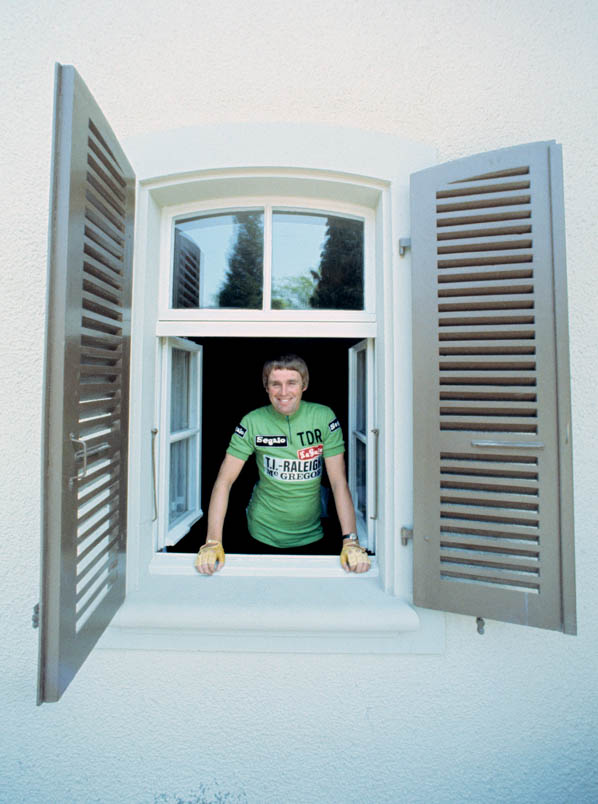
A beaming Hennie Kuiper poses in the green jersey of the Tour de Romandie, as the large TDR initials on his left breast show
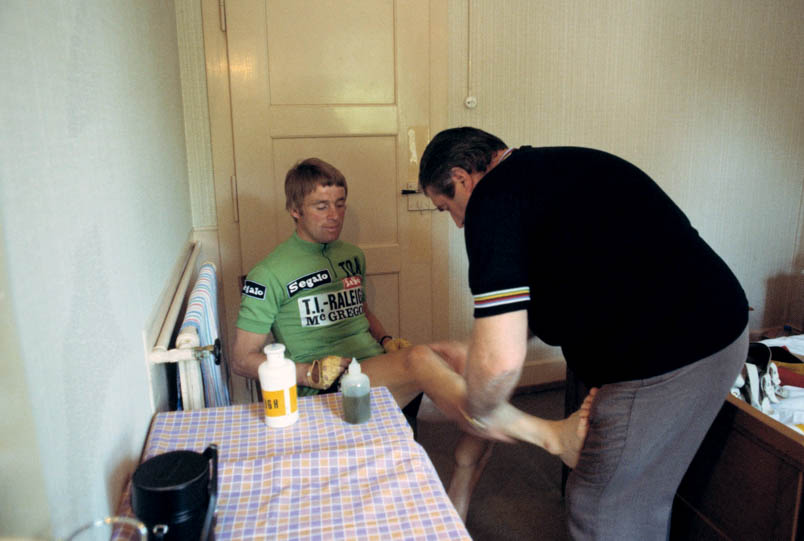
A scene stripped of all luxury. Not even a blind horse could do any damage in Hennie Kuiper’s hotel room. During the Tour de Romandie the race leader is tended by ‘Fat Jos’ Janssens
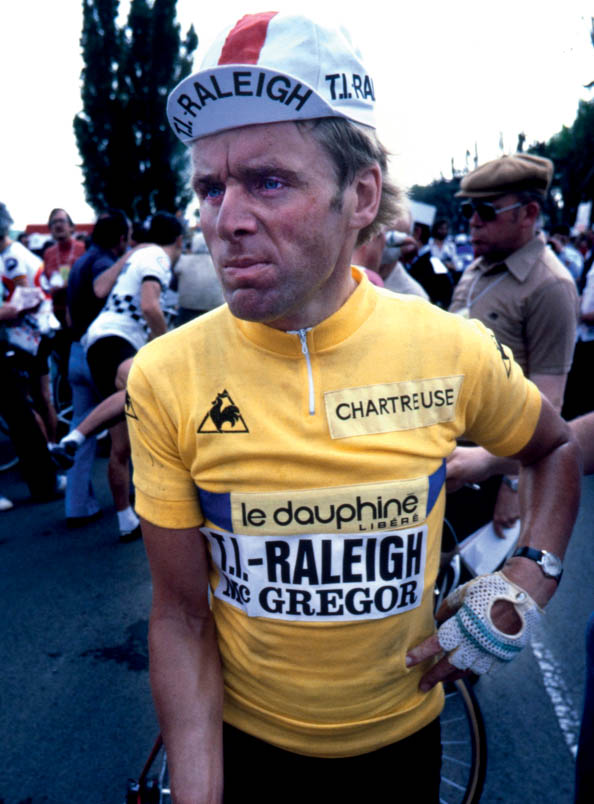
In the 1978 Critérium du Dauphiné Libéré, Hennie Kuiper gets to pull on the leader’s yellow jersey on 29 May after the 8-kilometre prologue in Thonon-les-Bains
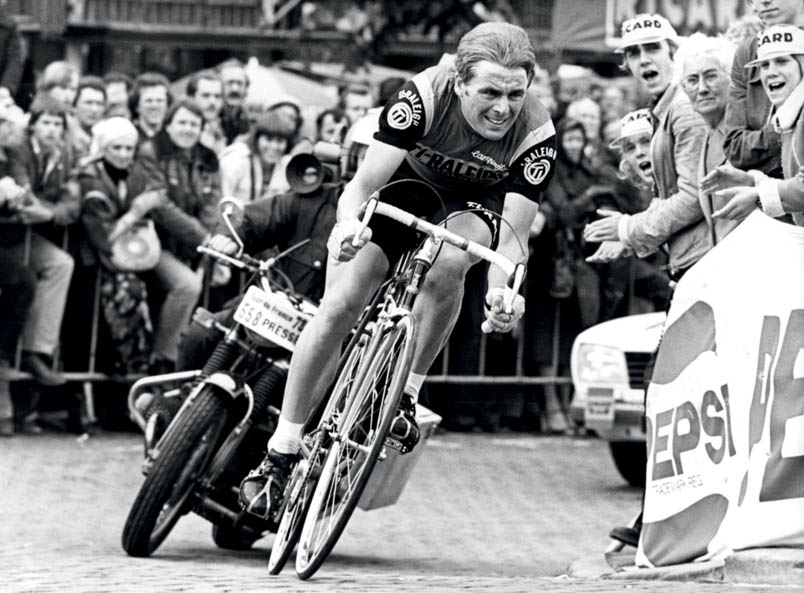
Hennie Kuiper races through Leiden, host of the prologue of the 1978 Tour de France. For Kuiper the cobbles are dry. The heavy rain that falls later gives the Tour boss Félix Lévitan his reason to strike the prologue from the classification
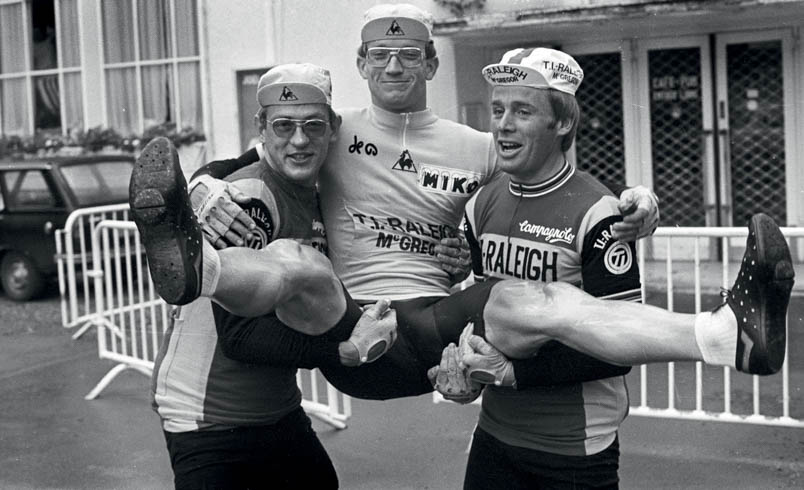
On the second day of the 1978 Tour de France Jan Raas gets his revenge. After Lévitan has struck the result of the prologue (won by Raas) from the classification, the Zeelander grabs the yellow jersey after all in Sint Willebrord, the finish of stage 1A. Gerrie Knetemann and Hennie Kuiper share in the celebrations over the yellow jersey
Riders’ strike
That unprecedentedly long team time trial already makes this an exceptional Tour. But a riders’ strike puts the 1978 Tour de France among the historic editions. For days there has been grumbling in the peloton. The riders are fed up with constantly having to travel long distances after the stages to reach the next start town. Riders, mechanics and soigneurs no longer get enough rest. On three racing days two stages are ridden. That suits the Tour organisers, because it brings in more income from start and finish towns. Gerben Karstens is the instigator of a strike, and in the twelfth stage, from Tarbes to Valence-d’Agen, he gets the peloton behind him. The riders decide to make it a go-slow stage, riding at tourist pace across the full width of the road. In the finishing town the riders dismount and, led by Bernard Hinault, walk across the finish line. Hennie Kuiper is in the front row too. An unprecedented protest, which does in the end lead the race management to take the riders’ wishes into account from then on.
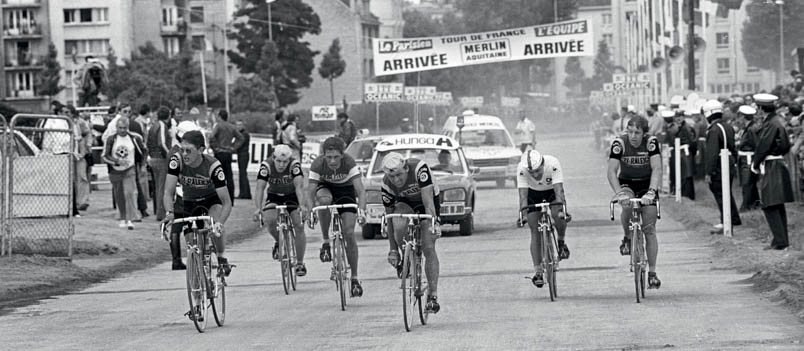
The Raleigh speciality that warms directeur sportif Peter Post’s heart. The fourth stage, from Evreux to Caen over 153 (!) kilometres, falls to the TI-Raleigh team. Six Raleigh riders cross the line as winners in Caen (from left to right): Gerrie Knetemann, Wilfried Wesemael, Henk Lubberding, Hennie Kuiper, Klaus Peter Thaler and José De Cauwer
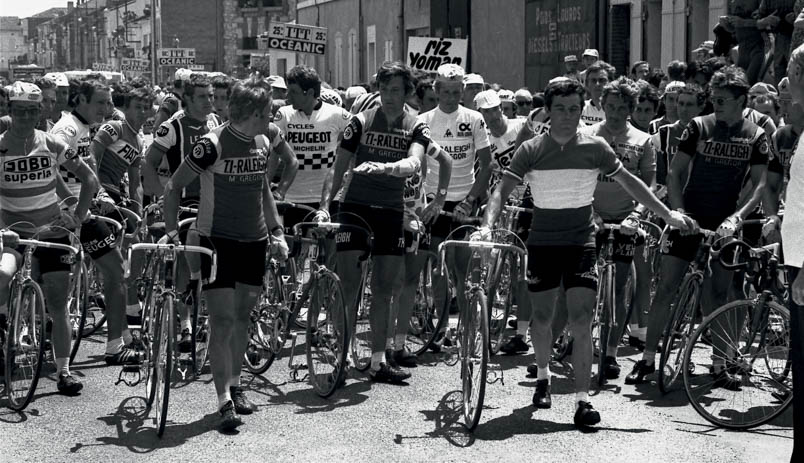
When Bernard Hinault orchestrates a riders’ protest against the murderous stage schedule in Valence d’Agen in the 1978 Tour de France, Hennie Kuiper is in the front row too. In the middle of the peloton Gerben Karstens urges Kuiper to stay calm: let Hinault take the lead as strike leader, and the protest will have the most impact. To Hinault’s right stand Freddy Maertens and Gerrie Knetemann. Between Karstens and Hinault, in the white jersey: Henk Lubberding
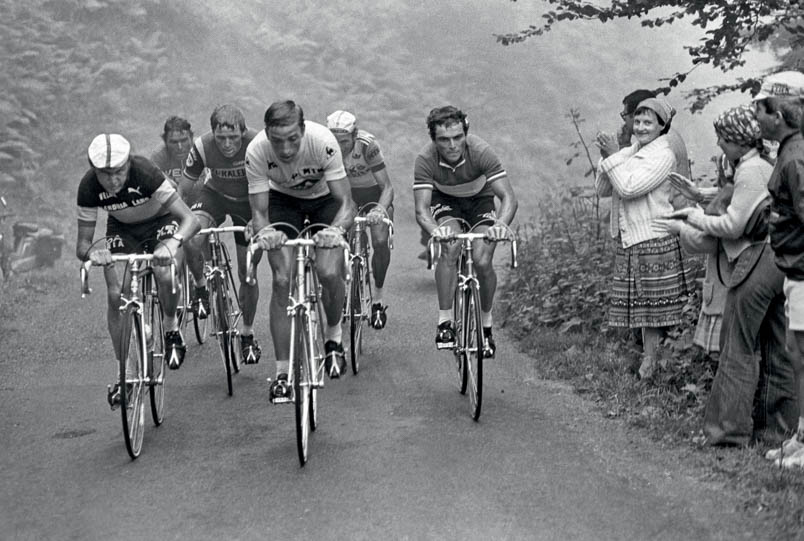
The mountainous Tour stage between Biarritz and Pau in 1978 is won by Henk Lubberding, who at this stage of the battle, however, has to let this illustrious company go. From left to right: Michel Pollentier, Joaquim Agostinho, Hennie Kuiper, race leader Joseph Bruyère, Joop Zoetemelk and Bernard Hinault
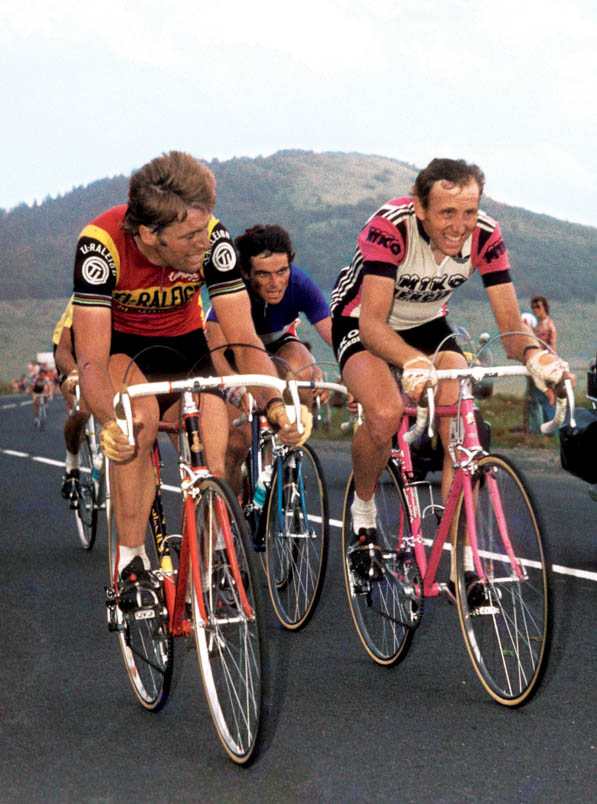
In the thirteenth stage of the Tour, to Super Besse, Hennie Kuiper, Bernard Hinault and Joop Zoetemelk test each other’s mettle
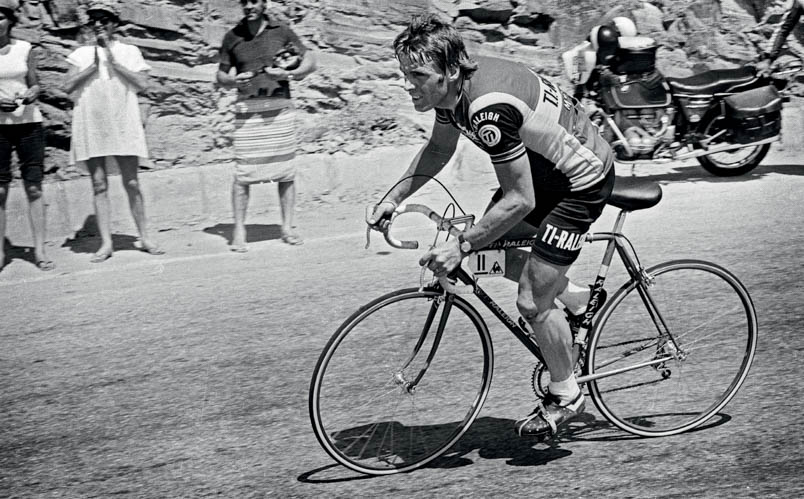
A gruelling day in the 1978 Tour. The individual uphill time trial scheduled for 14 July – the French national holiday – covers 52 kilometres and climbs to the summit of the Puy-de-Dôme, the largest volcano in the Auvergne. Hennie Kuiper – in top form – conquers the climbing kilometres on an ‘ordinary’ bike
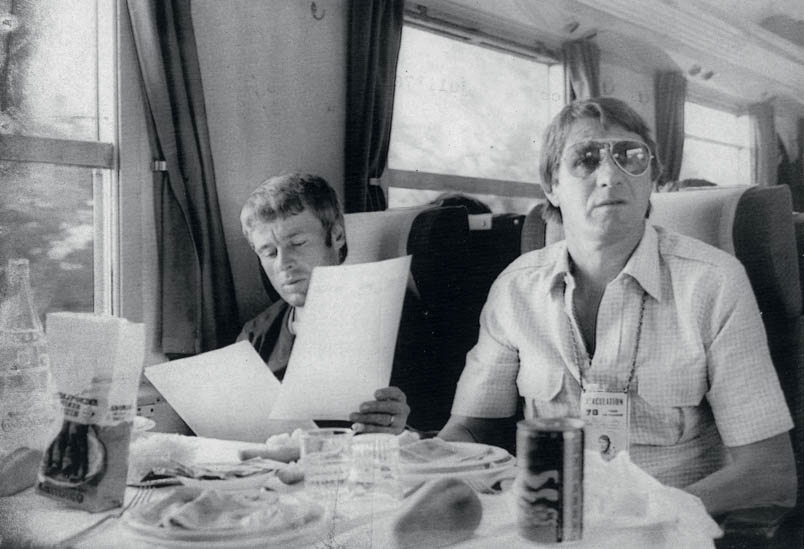
Before the start of the thirteenth stage of the 1978 Tour, the peloton travels by train from Toulouse to Figeac. Peter Post and Hennie Kuiper have breakfast together, but Kuiper still studies the day’s route map intently
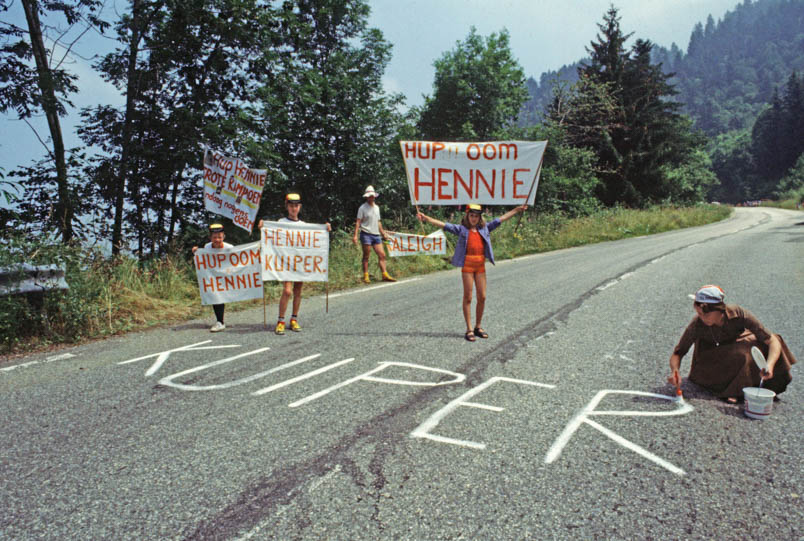
Hennie Kuiper is exceptionally strong in the 1978 Tour de France. In the Alps his family give him some heartfelt encouragement: ‘Hup Hennie / Great Champion / Go and do it again today.’ On the right his sister Maria chalks Hennie’s name on the road. In the middle of the road, his niece Miriam. On the left, Hennie’s nephews Anton and Ronald Kuiper