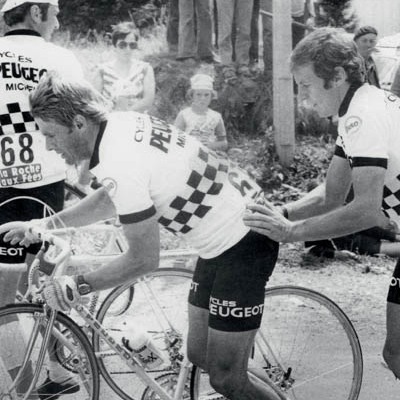
Joop wins, Hennie in the shadow
In the spring of 1980, his last season with Peugeot, one performance clearly stands out. In the great Ardennes race Liège-Bastogne-Liège, Hennie Kuiper is the best of the mere mortals. He finishes second in a classic raced in Siberian conditions. Hinault destroys the entire field. Kuiper finishes second in this polar expedition. When Hinault comes to grief in the Tour later that year, it is partly because of the hardship he suffered that spring. He has put his body through such an ordeal that he has to pay the price later in the season. The 1980 Tour becomes the Tour of Joop Zoetemelk and of TI-Raleigh. Joop certainly does not ride his best Tour de France, but he is surrounded by the strongest team: Peter Post’s. ‘And still Post wasn’t satisfied,’ says Peter Bonthuis, in those days the Raleigh directeur sportif’s right-hand man. ‘Winning the Tour, eleven days in the yellow jersey and eleven stage wins. And still angry. It should have been twelve… Unbelievable, but that was Post.’
In Joop’s shadow Hennie rides to second place. He owes it mainly to a strong ride in the cobbled stage between Liège and Lille (second behind Hinault) and a number of very strong time trials. Hennie rode perhaps the best time trials of his career. In the long race against the clock between Damazan and Laplume only Joop Zoetemelk is better. But he leaves famous time-trial specialists such as Bernard Hinault – injured by then – Bert Oosterbosch and Joaquim Agostinho behind him. In the mountains, Hennie notices, his results are patchy. He gets through the Pyrenees very well, but in the Alps he finds that he can no longer stay with the best. He tries to hang on for as long as possible, but he does not always manage it. ‘Kuipertje’ (little Kuiper) has to suffer terribly to limit his losses. On the last hard mountain stage, to the summit at Prapoutel, he even briefly loses his second place to the Frenchman Raymond Martin. But in the time trial in Saint-Étienne (won by Zoetemelk) Kuiper manages to put that right. For the second time in his career Hennie stands on the podium in Paris. Hennie’s second place is drowned out by the jubilation around the winner, Joop. Kuiper has now finished second twice in the Tour de France. The first time, in 1977, the whole of the Netherlands celebrates that second place as a victory. In those days Hennie can do no wrong. The Tukker, as people from Twente are known, had become the nation’s darling. Three years later Hennie Kuiper stands on the same step of the podium: second. This time it is an anonymous second place. Ask anyone at random who finished second behind Joop Zoetemelk in the 1980 Tour and nine times out of ten you will get no answer, or the wrong one. ‘One second place, it turns out, is not the same as another. It does teach you to put things in perspective. People who in 1977 would knock over anything and anyone to congratulate me now almost push me off the podium to get to Joop. There is no respect for my second place. But that’s top-level sport for you.’
Kuiper ends 1980 without a notable win. Yet it is a good season, as fourth place in the final standings of the Super Prestige (the season-long consistency ranking) proves. Just behind Hinault, Fons De Wolf and Moser. He never finished higher in that ranking. After the Tour Kuiper does win two insignificant kermesse races. Whereas in 1980 Joop celebrates the finest victory of his career on the Champs-Élysées in glamorous Paris, Hennie has to make do with victory in Broek op Langedijk. A greater contrast is hard to imagine.
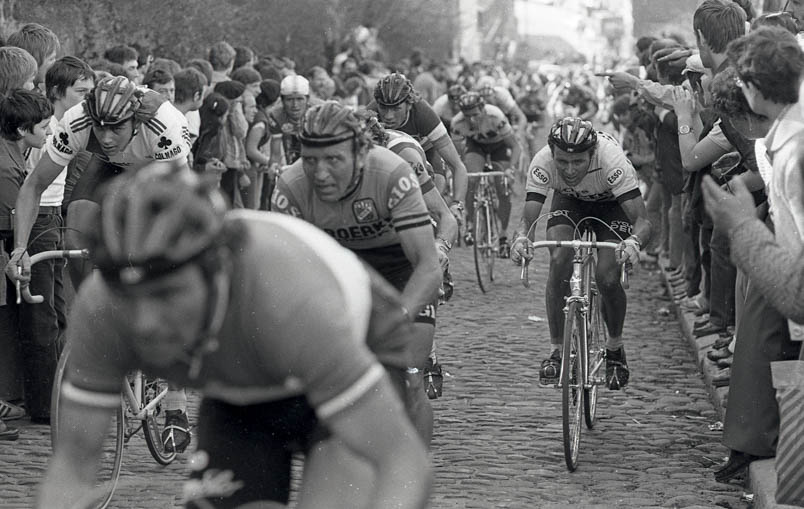
The 1979 Flèche Wallonne is raced flat out. Bernard Hinault is almost through. On the far left Fons De Wolf puts the hammer down. To De Wolf’s right, Walter Godefroot fixes his eyes on a point in the distance. Just behind Godefroot is Henk Lubberding in his national champion’s jersey. On the right, Hennie Kuiper tries to stay out of the crush
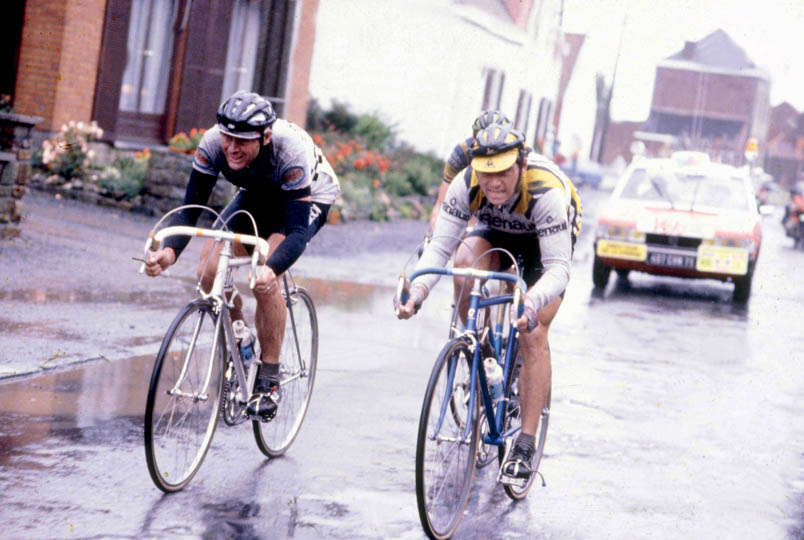
In the 1980 Tour Hennie Kuiper and Bernard Hinault ride a tremendous cobbled stage between Liège and Lille. It is real Hennie Kuiper weather, after all. Hinault beats Kuiper in the sprint for the stage win. Ludo Delcroix, almost invisible behind Hinault, will still concede almost a minute as third on the stage
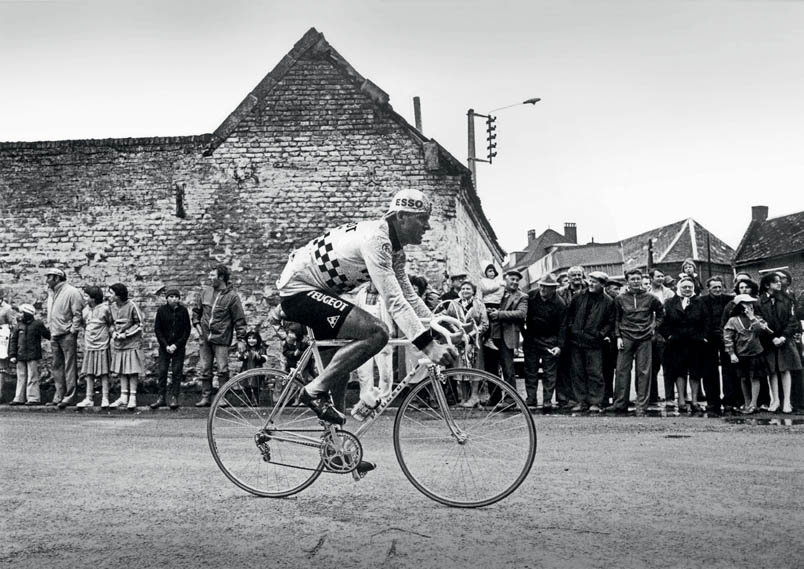
A typical northern French setting and a typical northern French crowd for the sixth stage of the 1980 Tour, between Lille and Compiègne
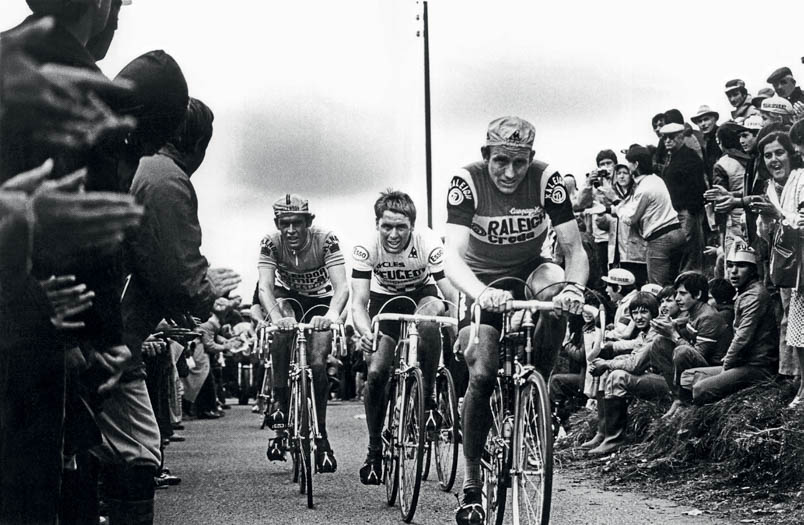
Glued to Zoetemelk’s wheel, with Johan De Muynck behind him. On the small climbs too, Hennie Kuiper is alert in the Tour stage from Lille to Compiègne
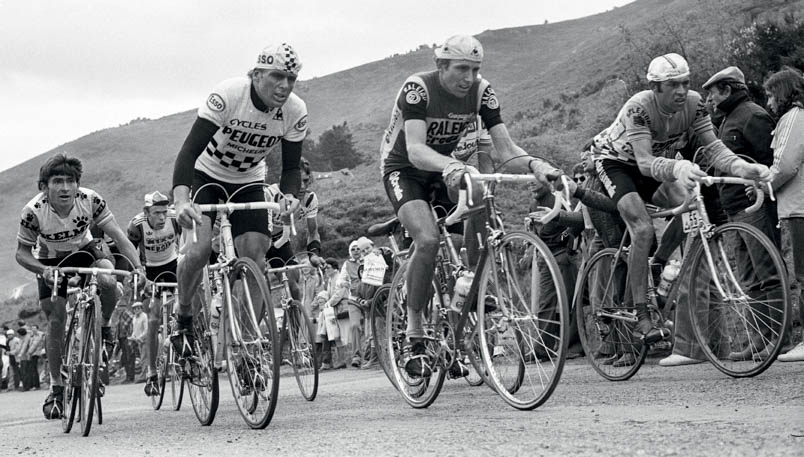
Tour stage 13 in 1980. From Pau to Bagnères-de-Luchon. From left to right: Vicente Belda, Christian Seznec, Hennie Kuiper, Jean-René Bernaudeau, Joop Zoetemelk and Johan De Muynck
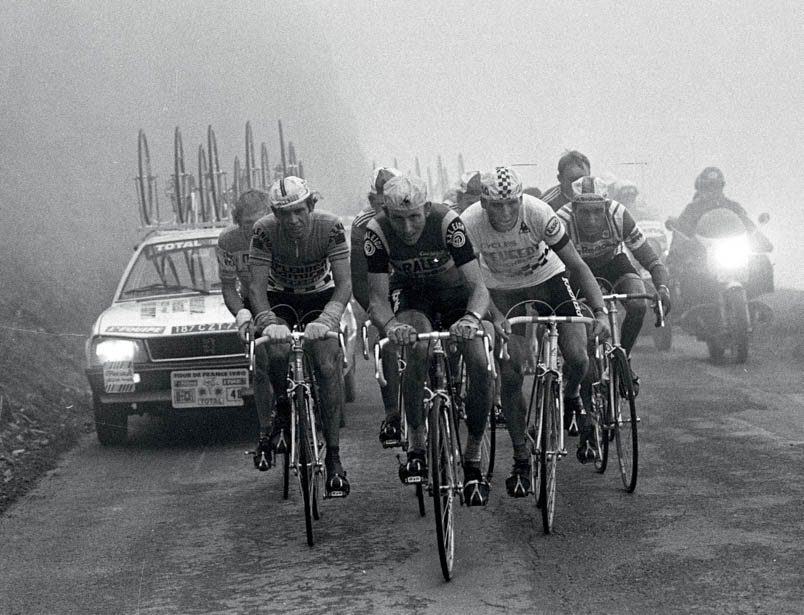
At the foot of the Tourmalet Raymond Martin has attacked, so Zoetemelk has to do the work on the front. The day before, Bernard Hinault had left the Tour with a knee injury. On the stage to Bagnères-de-Luchon Joop refuses to wear the yellow jersey, but Kuiper does force him to do all the work on the front. To Zoetemelk’s left, Johan De Muynck, with Ludo Loos behind him. To Zoetemelk’s right, Kuiper and Robert Alban
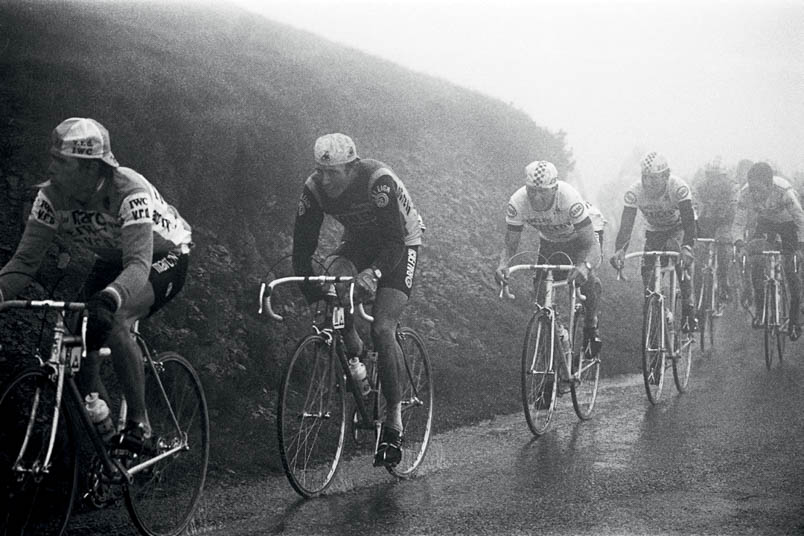
The summit of the Tourmalet is shrouded in mist. A ghostly group led by Lucien Van Impe, Joop Zoetemelk and Hennie Kuiper braves the fog
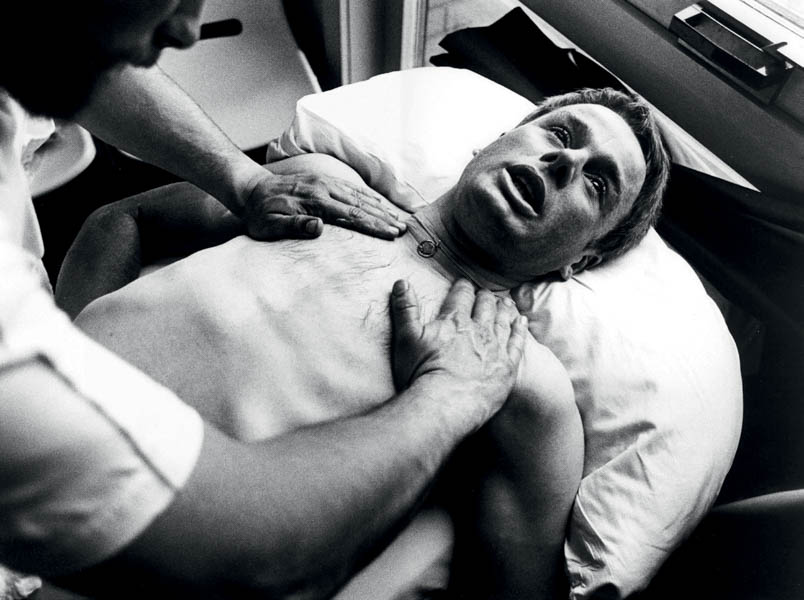
On the massage table in Luchon, Hennie Kuiper has the fatigue of a hard mountain stage massaged out of him
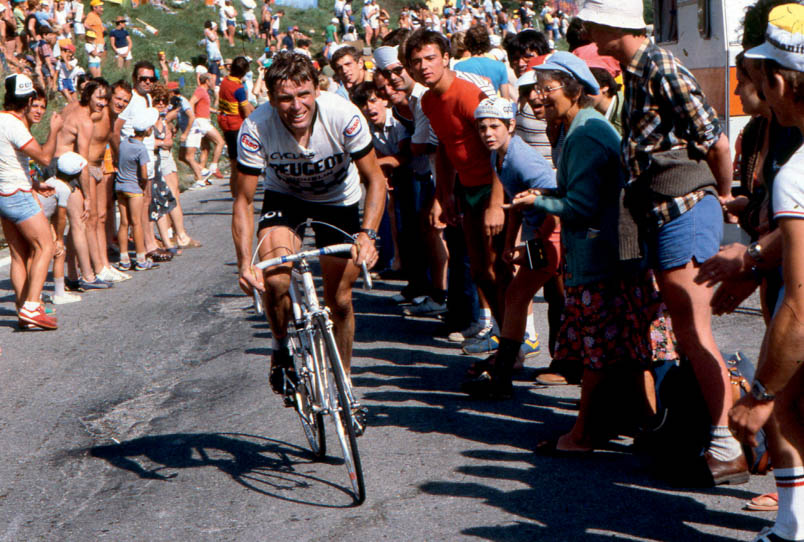
In both stage 17 and stage 18 of the 1979 Tour the finish was at the summit of l’Alpe d’Huez. On the mountain where Hennie made history in 1977, he suffered dramatic losses two years later. In stage 17 he struggled to the top all on his own, arriving 29th, more than 8 minutes behind the winner Agostinho and losing five minutes to rivals such as Hinault and Zoetemelk. The next day he did better. The winner Zoetemelk and Hinault proved too strong for him, but with eighth place he stayed in touch with the overall contenders
No leader
By then Hennie already knows that he will be leaving Peugeot. He has not been able to deliver what the sponsor expected of him. In the Giro d’Italia the Frenchman Jean-René Bernaudeau does a tremendous amount of work for the eventual winner, Bernard Hinault. The press writes glowingly about the young talent. At Peugeot they are eagerly on the lookout for a new star, and above all a French one. And Bernaudeau has, in principle, everything that makes him attractive to the French carmaker. Kuiper sees the storm coming early. Only if he can keep the new leader of the international peloton, Bernard Hinault, from winning the Tour – and only then – will there be a contract extension in it.
The love affair between the Dutch-Flemish duo of Kuiper and De Cauwer and the French riders has cooled by now. José De Cauwer soon realises that the Frenchmen sitting at the table together in the evening have all ridden brilliantly – at least by their own account. ‘Apparently they’ve all been fantastic that day: I rode on the front there; did this, did that. When I hear all that, I think: well, then I probably didn’t do anything at all.’ Looking back, Kuiper feels that he threw himself into the French adventure a little too eagerly. ‘After a few months I did find out that De Muer was really only concerned with his position in the ranking of French directeurs sportifs. The strategy was aimed above all at not letting Hinault, Guimard’s great trump card, win. And that with a team which, as I experienced it, was past its peak. Riders like Thévenet, Ovion, Sibille and Bernard Bourreau had had their best days.’
According to De Cauwer, the Peugeot period is a battle against great expectations. Kuiper would simply go and win the Tour. ‘From day one Hennie is expected to take on a leader’s role as team leader, but Hennie isn’t a leader. Nor is he always able to deliver at those moments when something big is expected of him. Hennie is no Merckx, no De Vlaeminck. He has to rely on hard work, then a brief flourish, and then off the stage. Leading a team with types such as Régis Ovion, Guy Sibille, Gilbert Duclos-Lassalle and Yves Hézard was never his thing.’
In the Peugeot years it is not only the laps around the church in the Netherlands that are a welcome source of income; there are pickings to be had at the criteriums in France too, if only because the sponsor also wants to see its team leader’s jersey in France regularly. Most criteriums are held in the period immediately after the Tour. The riders climb off the world’s toughest stage race exhausted, but have to get straight back to work if they want to collect the lucrative appearance money. That goes for Hennie too, who in every contract insists that his friend José can also be on the start line. It does mean covering enormous distances. It regularly happens that Hennie has to be at the start in the Netherlands one day and somewhere deep in France the next.
José, jack of all trades
De Cauwer invariably acts as chauffeur. In 1979, in the space of a month, De Cauwer drives thousands of kilometres that way. He is the chauffeur, collects his team leader’s race number and makes sure they both have somewhere to stay. On top of that, he is also riding the criterium in question. José remembers the time when they once again set off at night from his house in Temse, in the shadow of Antwerp, because they are expected the next day in a town south of Bordeaux. José, as usual, is at the wheel. Before they have even reached the French border Hennie is fast asleep. De Cauwer drives straight through the night; Hennie sleeps the sleep of the innocent.
When they finally arrive at their destination after that long, long drive, the team leader wakes up, rubs the sleep from his eyes, looks his friend up and down and says: ‘You look a sight!’ De Cauwer shakes his head. ‘It’s unbelievable, but he doesn’t realise that at that moment I’m completely wrecked after so many hours behind the wheel.’
Another, emotional example is the drive to Brittany, where Hennie is on the bill for a criterium. José is driving again, of course. The two men sit side by side in silence. José: the ever-ready helper, chauffeur, fixer, tactician, rescuer in many a crisis, domestique in the race – in short, the jack of all trades. And Hennie beside him. The supremely driven cyclist, forever working to improve himself, the man of matchless willpower with only one focus: cycling.
José’s thoughts are at home. With his Jeanne, who is suffering from Hodgkin’s disease, who has few prospects left, who is everything to him. She may well die. His emotion is understandable. He wants to share the sorrow and the pain. And who better to share it with than the other half of the partnership, Hennie, with whom he has been close friends for years now? José says: ‘Hennie, lad… I don’t think it’s going to end well at home.’ Hennie’s answer, which he later deeply regrets, is crushing. ‘If that’s how it is, that’s how it is.’ Not a shred of empathy in it. Tears run down José’s cheeks. He says: ‘But Hennie…’ And he falls silent. He knows what Hennie is like, but this really is very extreme.
Only later does it sink in with Kuiper. He never wants to cause anyone pain or hurt. That is not what Hennie is like. Afterwards he shows how deeply sorry he is. In many words, and in a letter. ‘He must have apologised a thousand times. By rights you should hold that attitude against him, but if you know him – as I do – you know he doesn’t mean it like that. But it’s very hard for me all the same. At the very moment you’re looking for a bit of support, you get an answer like that. I know how he’s made. He’s absent. As always, busy with the racing. Hennie lives in his own world.’
Hennie Kuiper takes stock of his two seasons with Peugeot. A fourth and a second place in the only race that matters in French eyes, the Tour de France. You cannot possibly call that a ‘fail’. On the contrary: it is tremendous! But he has not become the winner De Muer saw in him two years earlier and that he himself so fervently hoped for. So after directeur sportif De Muer’s overtures towards the young talent Bernaudeau, Hennie weighs up his options: he goes looking for a new employer. Fate now turns out to be on his side. In the 1979 Tour, on the rest day in Morzine, he receives a visit from Willy van Doorne, director of the DAF car company, which started a cycling team that year. He makes Hennie a fine offer. He wants Hennie to strengthen the DAF cycling team from the following season. The offer is eagerly accepted.
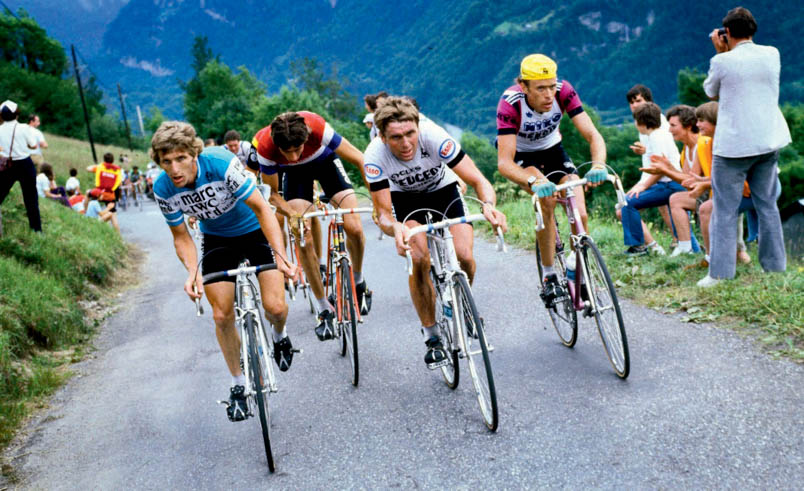
Ludo Loos (left) will win the stage to Prapoutel. National champion Johan van der Velde squeezes out everything he has for Zoetemelk. Kuiper rides with a wild look in his eyes, and Christian Seznec (far right) holds his head between his shoulders in his characteristic way
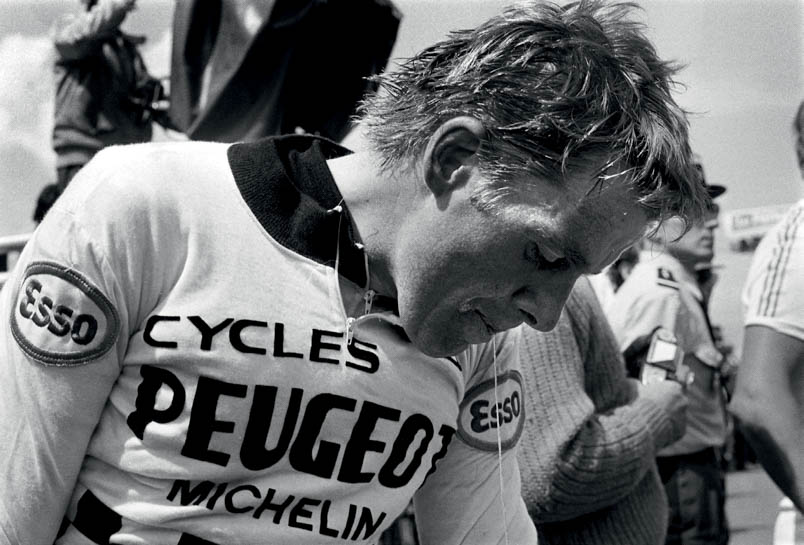
In Prapoutel Hennie Kuiper loses his second place in the classification for the time being. He loses more than two and a half minutes to Zoetemelk in the yellow jersey and almost two minutes to his closest challenger, Raymond Martin, who leapfrogs him in the classification
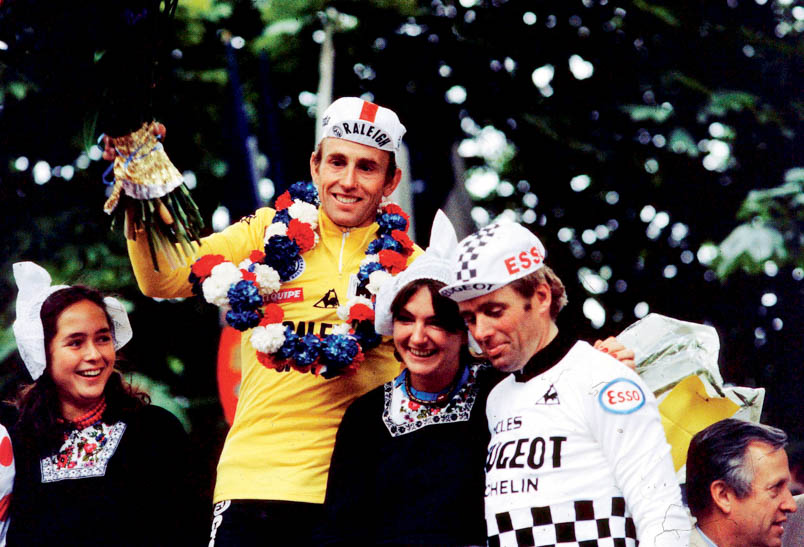
In Paris Hennie Kuiper is proud of his second place, but is visibly wrestling with mixed feelings. After Jan Janssen in 1968, in 1980 the Netherlands once again has a Tour winner, in the person of Joop Zoetemelk